For the better part of three years, the hottest seat in London's multi-manager world was a European rates book: lever up French OATs in repo, clip the carry, collect the seven-figure payout. This month, the French bond market sent the bill.
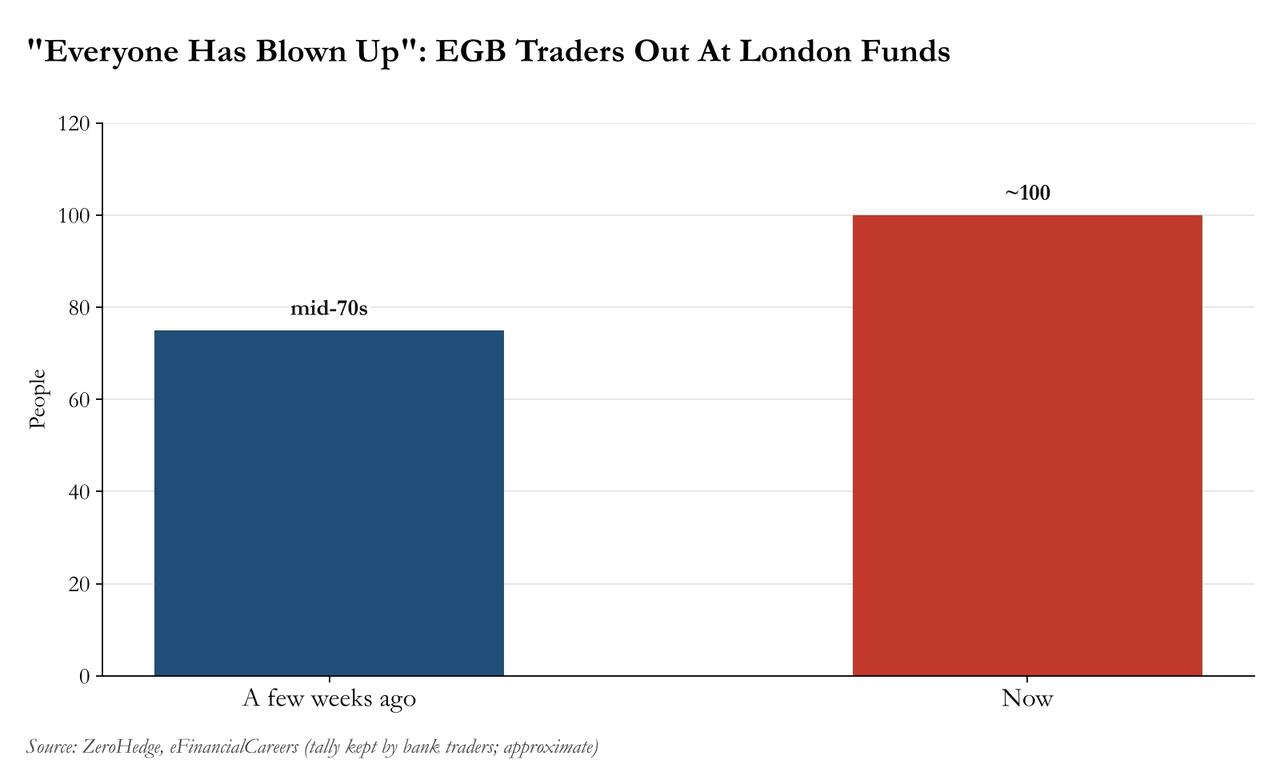
According to a must-read report from eFinancialCareers' Sarah Butcher, London's macro hedge funds are quietly emptying out their EGB desks. Funds aren't talking about performance, but headhunters and bank traders who have been keeping score say the count of ejected European rates PMs and traders has climbed from the mid-70s a few weeks ago to close to 100 people. One senior trader at a liquidity provider summed it up in four words: "Everyone has blown up... they are all out"
In other words, the most crowded trade in European fixed income just found out what happens when the collateral is the problem.
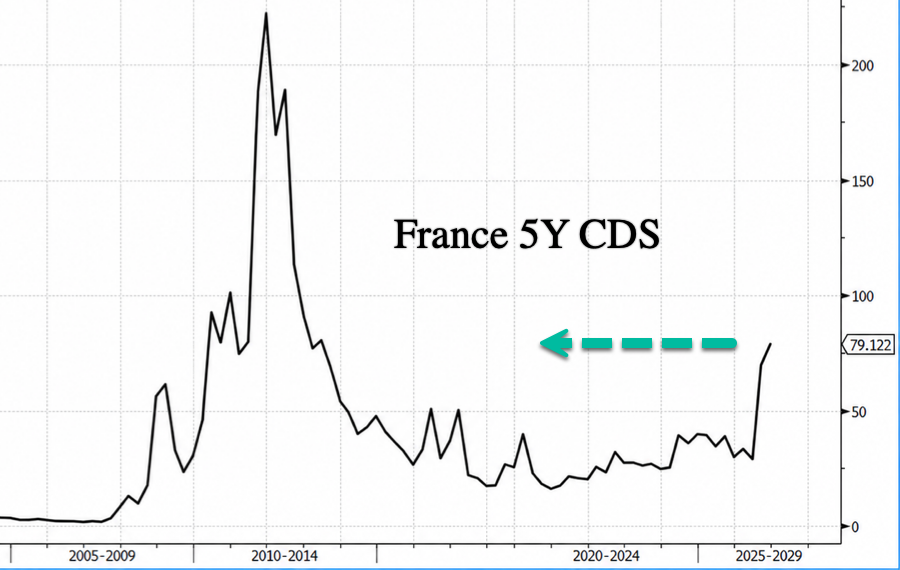
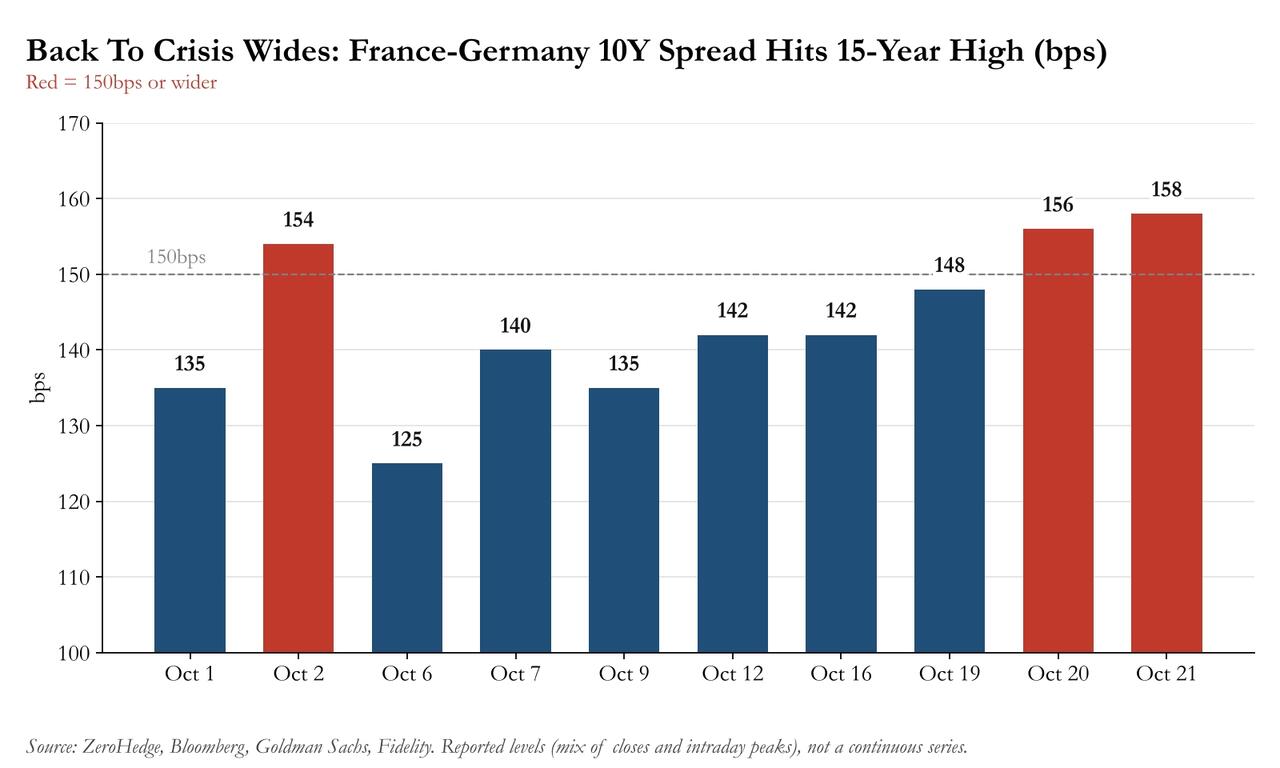
And the bleeding hasn't stopped. This morning Bloomberg flashed that the French bond risk gauge is nearing 160bps, a fresh 15-year high, while French 10Y yields hit 5% for the first time since July 2002.
Below we walk through what blew up, why it blew up (twice), what Goldman, Morgan Stanley and the rest of the Street make of it, and why the market's attention is already drifting to the next domino: Italy.
The Trade: Borrow Against France, Pocket The Difference
The mechanics were simple enough to fit on a Post-it. Funds bought French government bonds, financed them in the repo market using those same OATs as collateral, and pocketed the gap between the bond's yield and the repo cost. Lever it up enough times and a few basis points of carry becomes a career. Per eFC, as French yields rose amid political chaos, OATs sold off and the whole highly leveraged structure was turned upside down.
A bank trader watching from the sidelines was less charitable:
"These people weren't even real portfolio managers," claims one senior trader, watching from the sidelines in a London bank.
"They were just using EGBs as a carry asset. Buying bonds, sitting on the carry and getting a percentage cut. It was fun for a while. You had a lot of PMs who were long France and long Italy, but with inflation coming in and rates high, it wasn't going to last."
Another PM in the sector offered a more philosophical take: "every bubble gets its moment."
The wider version of the trade, as Bloomberg reported on Oct 2, was the OAT asset-swap: funds including Taula Capital and Balyasny had built positions to harvest the spread between French yields and interest-rate swaps. Those were lucrative right up until the budget blowup of Oct 1, when the trades flipped from winners to liabilities and everyone hit the exit at once. RBC BlueBay's Kaspar Hense told Bloomberg what that looked like from the inside:
"Most typical hedge-fund strategies are in risk reduction mode. There have also been stop-loss levels triggered, partly on the steepener trades and now on long France trades." (emphasis ours)
— Kaspar Hense, RBC BlueBay Asset Management, via Bloomberg
Fidelity International's fixed income CIO Marion Le Morhedec went further, estimating that hedge fund activity could explain roughly half of the recent moves in the French-German spread, pointing to particularly heavy Eurex activity. Turns out the "liquidity providers" were also the liquidity takers.
Regular readers will recall that we called this one in real time on the very first day of the month:
it's been a while since we had a European sovereign debt crisis
— zerohedge (@zerohedge) October 1, 2026
*FRANCE-GERMANY 10-YEAR YIELD SPREAD WIDENS 8BPS TO 135BPS
France CDS widest in 13 years
...which was followed hours later by "Debt Crisis Back? European Bond Markets Crash, CDS Explode Amid France Budget Panic Contagion" (Oct 1). By the next day, the OAT-Bund spread hit 154bps, the widest since 2011, and the deleveraging was in full swing.
Same Trade, Same Crowd, Same Exit Door
The most damning detail in the eFC piece: according to the liquidity-provider trader, many of the PMs who blew up this month had already blown up in March, on the same positions. That was when the Iran war and the Hormuz shock triggered the first great European rates unwind, and when, per Bloomberg, multi-strats from Millennium to Balyasny to ExodusPoint gave back some or all of their year-to-date gains as crowded trades unwound.
Seven months apart, the same book got carried out twice. Diversification at its finest.
"They've blown up twice on the same trades."
Another trader observes that a lot of funds moved into the European fixed income space in the belief that it was easy money:
"The whole European carry system is now being questioned."
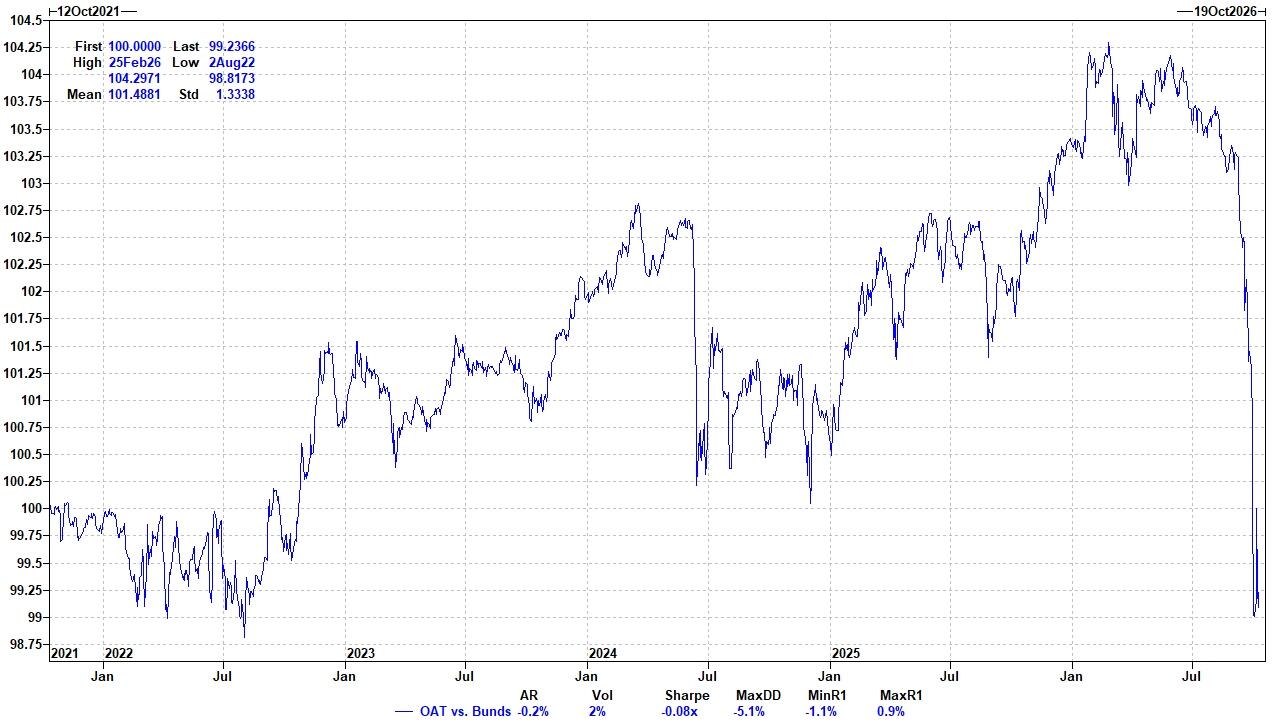
You can see both episodes in Goldman's own long-OAT/short-Bund rolling futures basket, which the bank's Systematic Trading Strategies desk circulated to clients: a steady grind higher for three years, a wobble in March, and then a near-vertical collapse that has wiped out roughly five years of gains as the basket fell from a February peak of ~104.3 to ~99.2.
Goldman's STS desk described the October contagion mechanism in that same note (available to pro subs here):
OATs have come roaring back into market focus over the last month. Where an unwind of popular rates positions following the latest ECB meeting (mostly steepeners), seemed to spread to wider carry trades in the rates space among a bid for volatility. A weak starting position for France with regards to debt and fiscal background and uncertainty into next year's election as well as challenging budget process didn't help. (emphasis ours)
— Goldman Sachs STS, Tim Huiszoon, Oct 12
Translation: the steepener crowd got stopped out first, then the losses bled into every other levered carry position on the same risk books. Not a fundamental repricing so much as a margin call with a French accent.
Allianz Trade agrees, noting in an Oct 9 report that speculative shorts, hedge-fund asset-swap unwinds and thin liquidity created a negative loop, with market depth more than 50% below normal:
"The speed reflects a positioning shock, not a pure repricing of fundamentals. Long-term investors are sitting out ahead of the elections... Fragmentation is far from 2012 or 2020 levels, but the ingredients are in place." (emphasis ours)
— Allianz Trade, "Toasted, not burnt", Oct 9
Note the second sentence: the real money that would normally buy the dip is sitting on its hands until the election. Which leaves... nobody.
The Plumbing Problem Nobody Wanted To Talk About
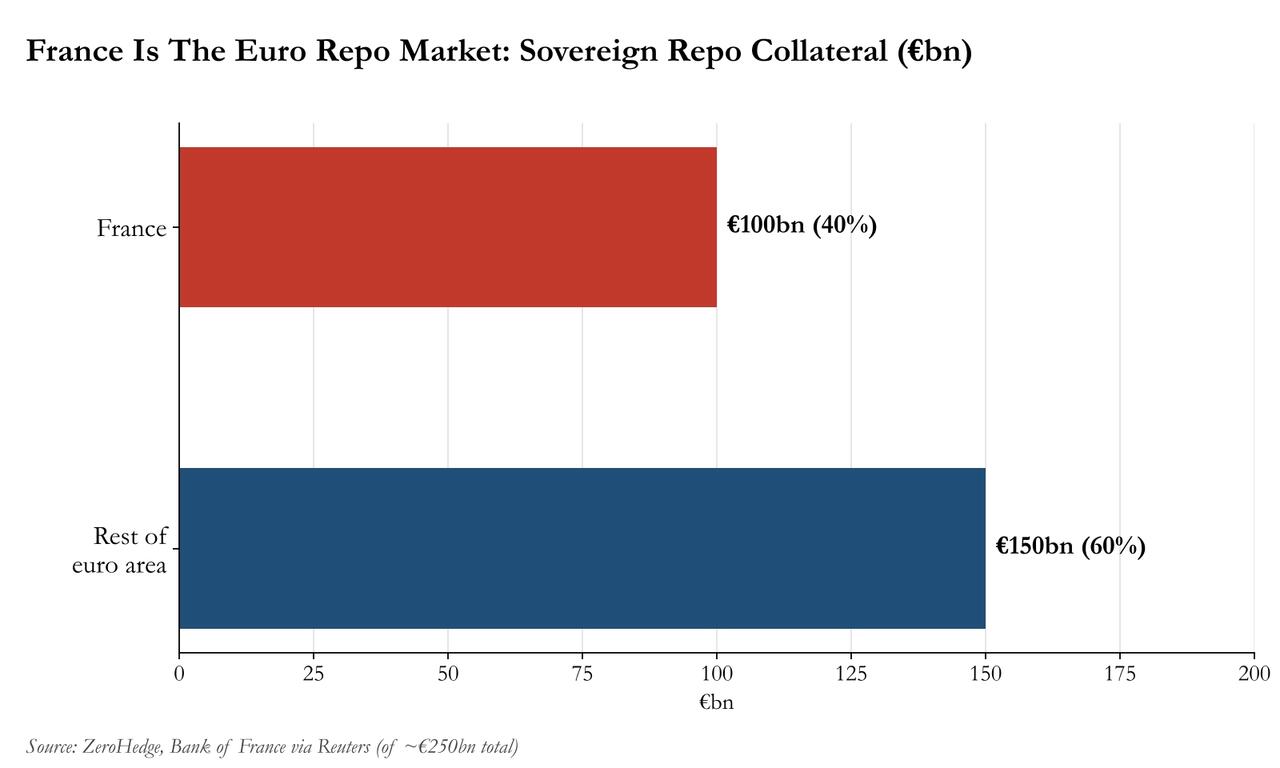
It's not just about P&L. Hedge funds have stepped in as the marginal provider of liquidity in European sovereigns precisely as central banks, pensions and banks stepped back. Per Bank of France data cited by Reuters, French government debt accounts for roughly €100 billion of the €250 billion in euro-area sovereign bonds pledged as repo collateral. In other words, France is the euro repo market.
So far the repo market itself has held up, but the risk is obvious: a further ratings cut narrows the pool of institutions able (or willing) to take OATs as collateral, which raises funding costs, which forces more selling. Commerzbank flagged exactly this back in September after Fitch's downgrade:
"...once a second agency downgrades to single-A, OAT repos may cheapen visibly, similar to BTPs, where more than half of bonds already trade above the depo rate." (emphasis ours)
— Commerzbank, via MNI, Sep 16
With Moody's reviewing France on Friday, that is not exactly a theoretical concern. And as we noted when the sell-side spent a day insisting the OAT rout was "just positioning," the contagion had already jumped to the banks, with the selloff reactivating Europe's "doom loop" (Oct 7). Goldman's European financials desk is still hiding under the desk:
"We are staying in risk off mode on banks (topics remains Euro sovereign crisis fear + Rates + Competition + Agentic, ie peak ROTE)... Appetite for French banks is very low given how long it will take to have some clarity." (emphasis ours)
— Goldman Sachs EU Financials specialist sales, Oct 20
"Overshot Fundamentals"... Says Goldman (Two Weeks Ago)
To be fair to Goldman, the bank has been leaning against the panic. Its strategists argued earlier this month that the OAT selloff appeared to have overshot fundamentals, amplified by positioning, though they conceded France is cheap relative to peers but lacks a catalyst. GS's STS desk went further on Oct 12, flagging GIR's expectation that the spread stabilizes at tighter levels and pitching a 1-year principal-protected option on OATs vs Bunds as a reversal trade with the 10Y spread at ~135bps.
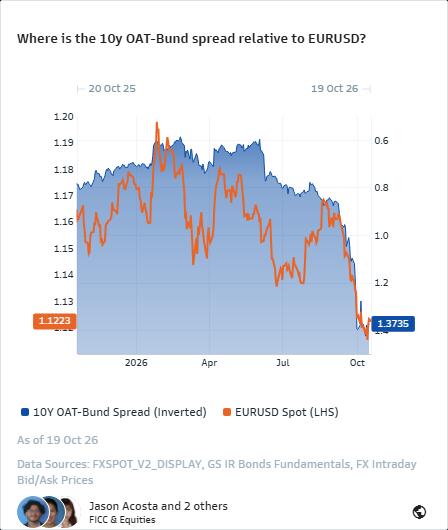
The market had other plans. After weekend riots across France (nearly 2,400 arrests), the spread widened another 8bps to ~145bps on Monday, per Goldman's Daily Monitor, which ran this as its chart of the day: the OAT-Bund spread (inverted) dragging the euro down with it.
Goldman's FX desk confirmed the hedge funds were already heading for the exits:
"EUR option volumes – which have been an key indicator for broader portfolio hedges – have also decreased and are more than 30% off the highs. Certainly, a lot of hedges have been put on already and broad de-risking across popular positions was a hallmark of last week's activity." (emphasis ours)
— Goldman Sachs FX desk, Oct 19
Bloomberg's Vassilis Karamanis reads the same options market more darkly: the premium for longer-dated euro downside now exceeds short-dated, suggesting the euro's weakness "reflects more than a positioning adjustment." So much for "just positioning."
By Monday's close, French 10Y yields had posted their highest close since 2002 (Oct 20), and on Tuesday the spread hit a 156bps peak:
French bonds getting smashed: OAT-Bund spread back to crisis wides.
— zerohedge (@zerohedge) October 20, 2026
Expect ECB monetization demands to return
And this morning the milestone everyone was waiting for finally printed: per Bloomberg, French 10Y yields hit 5% for the first time since July 2002, with the OAT-Bund spread out another 5bps to 158bps as Brent traded above $110. So much for stabilizing at tighter levels.
Goldman's own economists, meanwhile, aren't buying the government's numbers either. In Tuesday's European Daily, Alexandre Stott writes:
"Recent protests over school underfunding and cost-of-living pressures have been among the largest since the pension reform strikes of 2019 and 2023 and the 'yellow vests' movement of 2018... we remain sceptical that the government will meet its deficit target of 5.0% of GDP next year... Our poll-based model therefore continues to see Le Pen as the clear favourite to become President next year." (emphasis ours)
— Goldman Sachs, European Daily: France—Budget Adoption Likely Later This Year, Oct 20
Morgan Stanley's chief global economist Seth Carpenter, whose note we published on Oct 11, is just as blunt about the arithmetic, and about the cavalry:
At wider than 150bps, the 30yr OAT-Bund spread surpassed the 130bp mark reached in the euro area debt crisis a decade ago... Debt stabilization would require a primary surplus of roughly 2% of GDP, a turnaround of about 5 percentage points. That shift would be larger than the adjustment required in Italy in the early 2010s... We think the bar for direct ECB intervention is very high, but France may not be the last test. (emphasis ours)
— Morgan Stanley, Seth Carpenter, Sunday Start
Put differently: the ECB is not coming to rescue anyone's carry book, and certainly not before Paris finds a fiscal squeeze bigger than the one Rome needed in 2011. Good luck with that during riots. Bill Blain, for his part, awarded a "No Sh*t Sherlock" prize to anyone who spotted European yields spiking after the riots, warning in Tuesday's Morning Porridge that the unrest could "metastasise into a potential bond crisis unless the ECB can swiftly demonstrate it is able, willing and stands ready to intervene."
Where Do 100 Ejected Rates Traders Go?
The career fallout is where the eFC report gets really fun. Some will drift back to the banks, where one headhunter said dealers need them to manage ECB exposure and bond books. The catch, per a bank trader: these PMs were pulling in $1 million-plus, a number that at a bank you only see as a desk head. Many are also tied up in non-competes, and some are still collecting guarantees and in no rush to find work. Good news for the departed PMs; allocators may see it differently.
Not everyone was pushed: one source estimated roughly 10% left voluntarily, some to raise their own funds, because allocators are struggling to find people both willing and able to take risk. Which is one way of describing a market where everyone who took risk just got carried out.
More ominous is the verdict from the trading floors: one trader told eFC that funds piled into European fixed income believing it was easy money, and that the whole European carry system is now being questioned. A bank trader called it systemic. And per the headhunter, the big fear now is that Italian BTP spreads go the way of OATs, a risk Morgan Stanley also flags, noting that wider OAT spreads are already putting pressure on BTPs.
Bottom Line
Goldman's bet is that this was a positioning flush: the levered carry crowd got shaken out, the forced selling is largely done, and spreads should drift back in. Maybe. But consider what has happened since the "overshoot" call: riots, a 5% 10Y, a spread nearing 160bps, a Moody's review on Friday, and a presidential race where Le Pen polls at 34%-38% in the first round. The forced sellers may be gone, but the natural buyers never came back, and the marginal bid in OATs for the past three years was a levered London pod that is now on gardening leave.
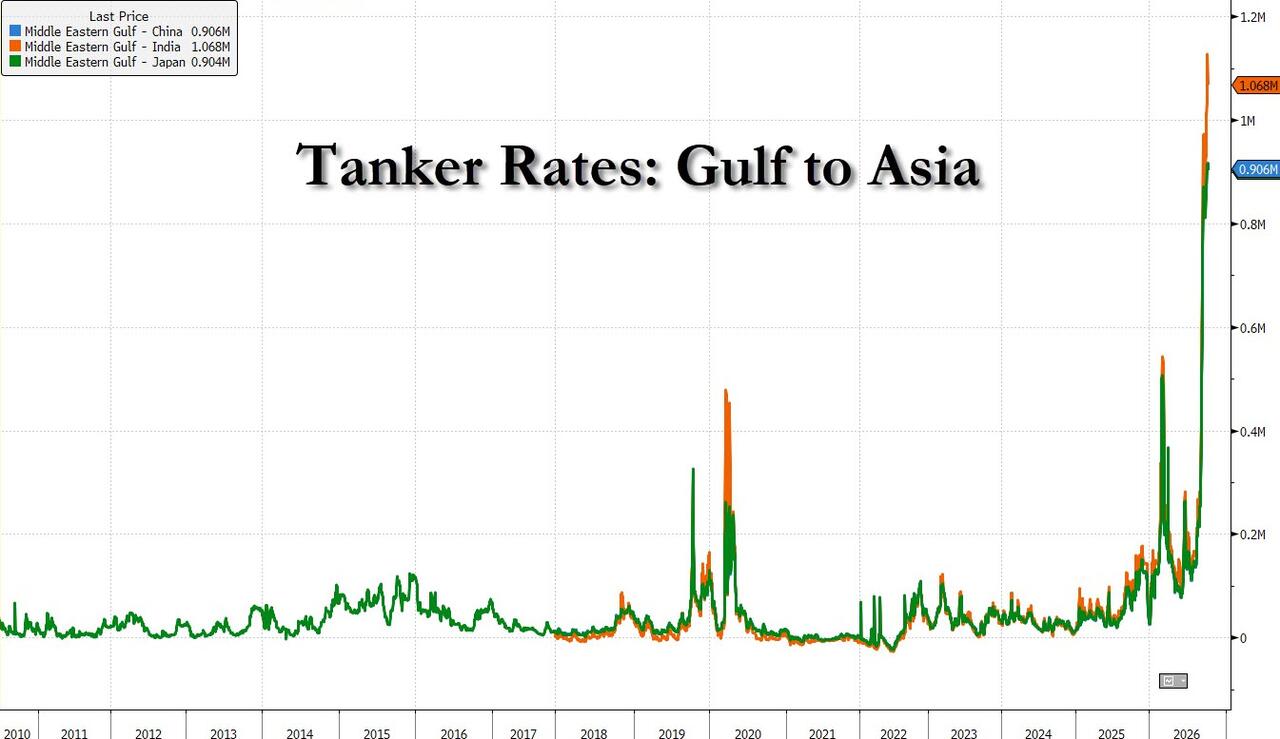
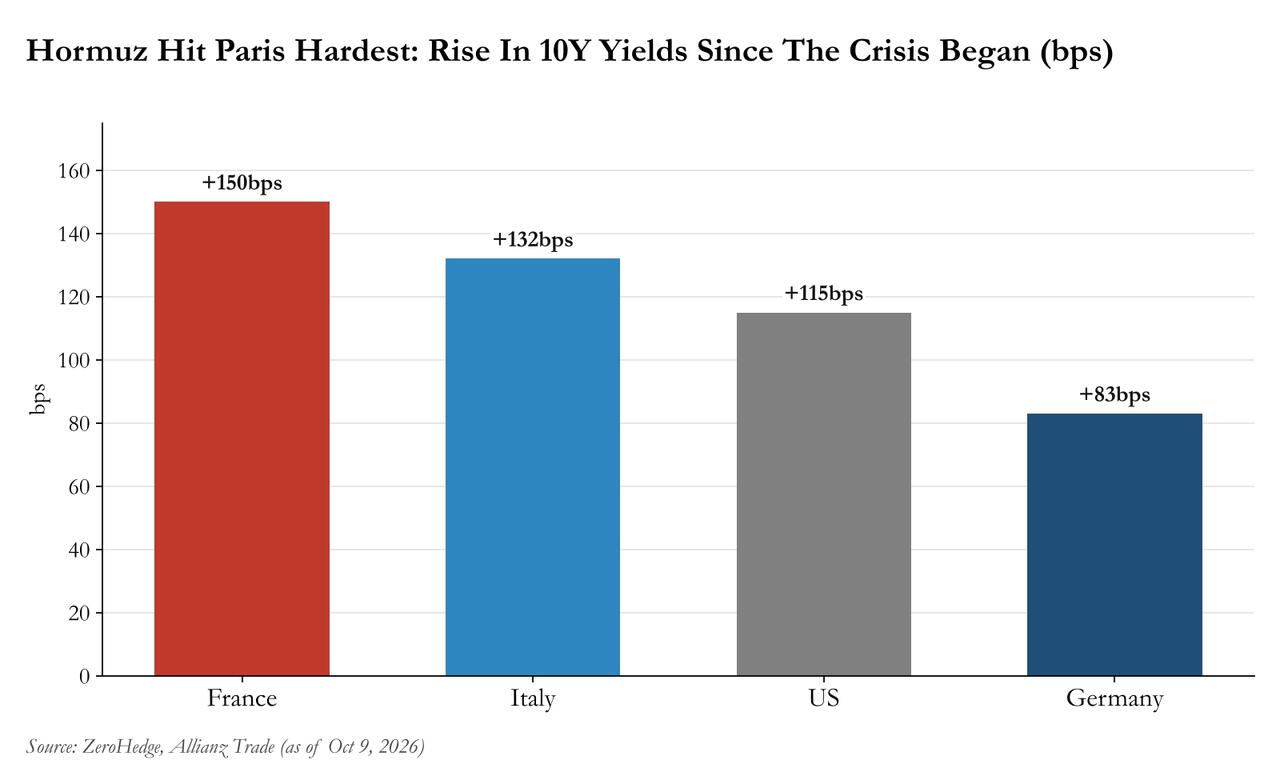
And this was never just about politics. Since the Hormuz crisis began, France has underperformed every major bond market, Italy included:
Which is why we lean toward the skeptics: this isn't the end of a positioning unwind, it's the beginning of a regime where France trades like the periphery, and where Italy, with the same crowd long it on the same leverage, is next in line. When the people who spent three years harvesting European carry are now warning that the asset class may never look the same, it's probably worth listening. Expect the ECB monetization chorus to get a lot louder. We'll check back after Friday's Moody's decision.
Much more in the full Goldman GS European Daily "France - Budget Adoption Likely Later This Year" note, both available to pro subs.