
Bloomberg reports that reactor developers Oklo and X-energy are joining a $200 million Trump administration-led program designed to speed new nuclear power plants for artificial intelligence data centers.
Details could be announced Wednesday at a Department of Energy AI energy summit. Microsoft and Nvidia are also involved in the previously announced initiative, while several DOE national laboratories and the University of Texas at Austin are slated to share $60 million over three years, according to a document seen by Bloomberg.
“Among the goals of the latest initiative are steep reductions in time needed to design, license and build new plants, as well as cuts in the number of staff needed to run them”
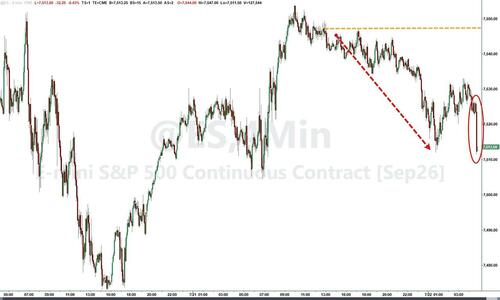
X-energy jumped as much as 12% after hours, while Oklo gained as much as 9.9%.
The program reportedly targets steep reductions in the time and workforce required to design, license, build and operate reactors. It would join a rapidly expanding federal nuclear support stack:
-
Westinghouse fleet program: At least $80 billion of aggregate project value for new AP1000 reactors, with the government arranging financing and facilitating approvals.
-
US-Japan partnership: Up to $40 billion of Japanese-backed investment for GE Vernova Hitachi BWRX-300 projects in Tennessee and Alabama.
-
Gen III+ SMRs: $800 million in cost-shared DOE awards, split between TVA’s BWRX-300 project and Holtec’s SMR-300 project.
-
Reactor Pilot Program: An expedited DOE authorization pathway for 11 initial projects, with developers responsible for project costs.
-
Advanced Reactor Demonstration Program: Roughly $3.2 billion in federal cost-share commitments for TerraPower’s Natrium and X-energy’s Xe-100 demonstrations.
Compared with those capital-heavy programs, the new $200 million effort appears aimed at a different choke point: potentially using AI, federal labs and industry partnerships to compress the paperwork and engineering timelines standing between reactor designs and power-hungry data centers.














































































































































































































































































































































































































































































.jpg?branch=production)