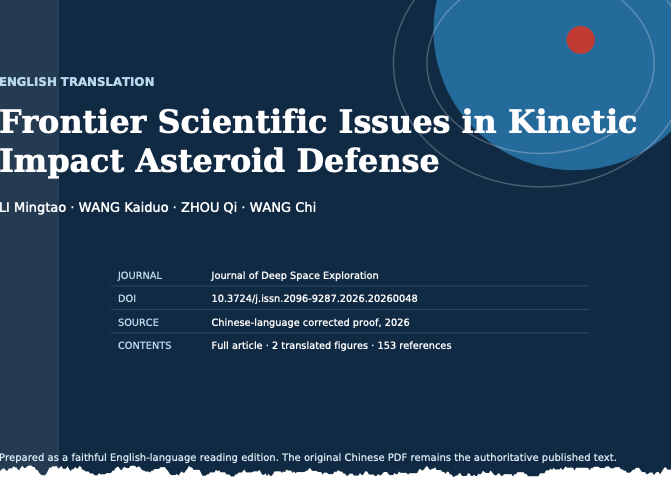
A new paper under peer review by the Chinese-language Journal of Deep Space Exploration lays out an ambitious plan to crash a spacecraft at Mach 26, or 20,000 mph, into a near-Earth asteroid to test new planetary defenses.
The South China Morning Post reports that a team led by Li Mingtao, chief scientist for planetary defense at the China National Space Administration, is planning a mission even more ambitious than NASA’s Double Asteroid Redirection Test (DART).
That mission would slam a spacecraft into 2015 XF261, an asteroid estimated to be about 30 meters wide, in either 2029 or 2030.
"Dart was the first to demonstrate asteroid deflection by kinetic impact in space, but it did not directly change an asteroid's orbit around the sun relative to Earth, making it different from a real planetary-defense scenario," the researchers wrote in the report.
The planned impact would be nearly 50% faster than NASA’s 2022 DART, which hit the asteroid Dimorphos at 6.1 kilometers per second, or about Mach 18.
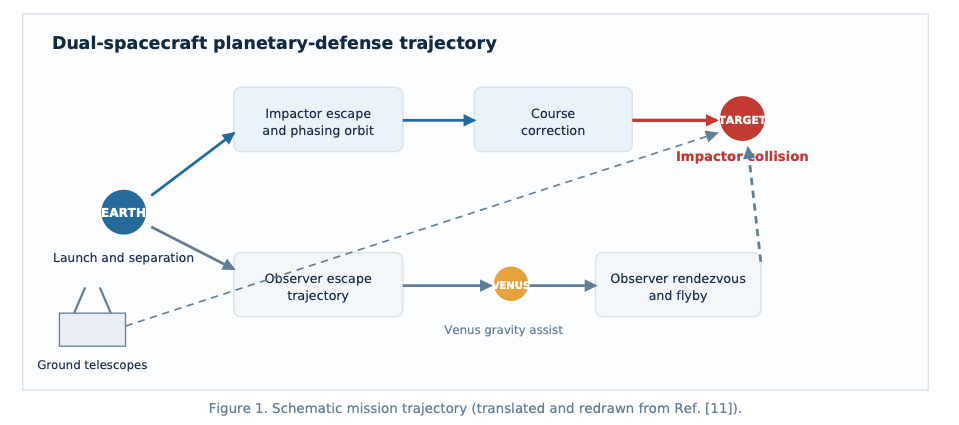
According to the paper, the mission calls for two spacecraft: one interceptor and one observation spacecraft, which would use a Venus gravity assist before rendezvousing with the target. It would deploy a small probe to monitor the collision and measure changes to the asteroid's orbit, shape, surface, and internal structure.
"Focusing on China's first asteroid-defense demonstration and verification mission, planned for implementation before 2030, this paper systematically reviews the frontier scientific questions in kinetic-impact asteroid defense to support mission design, implementation, and preliminary scientific research," the researchers said.
If successful, the test would become China's first end-to-end demonstration of an operational planetary-defense system. It will help scientists better understand how – and when – a kinetic impactor spacecraft could be used to deflect an Earth-bound asteroid.
Meanwhile, SpaceX will launch the NEO Surveyor asteroid-detection telescope no earlier than September 2027, which will discover and monitor most of the potentially hazardous asteroids and comets that come within 30 million miles of Earth's orbit.