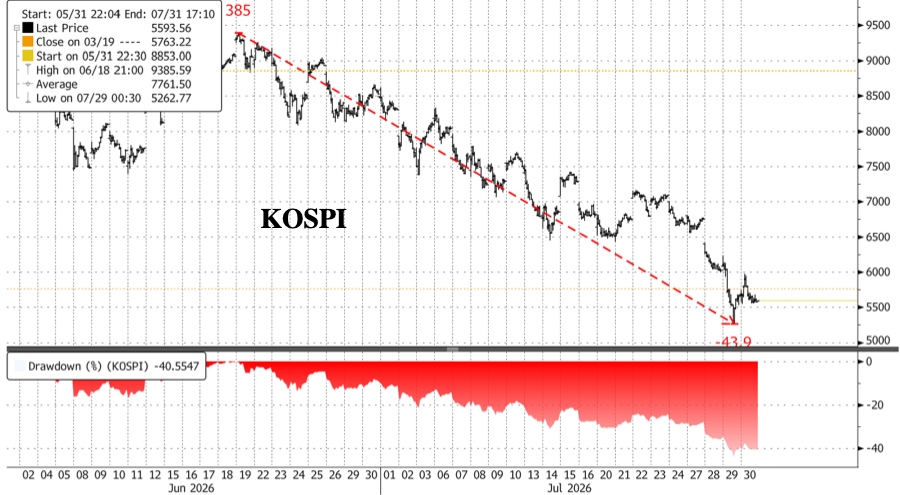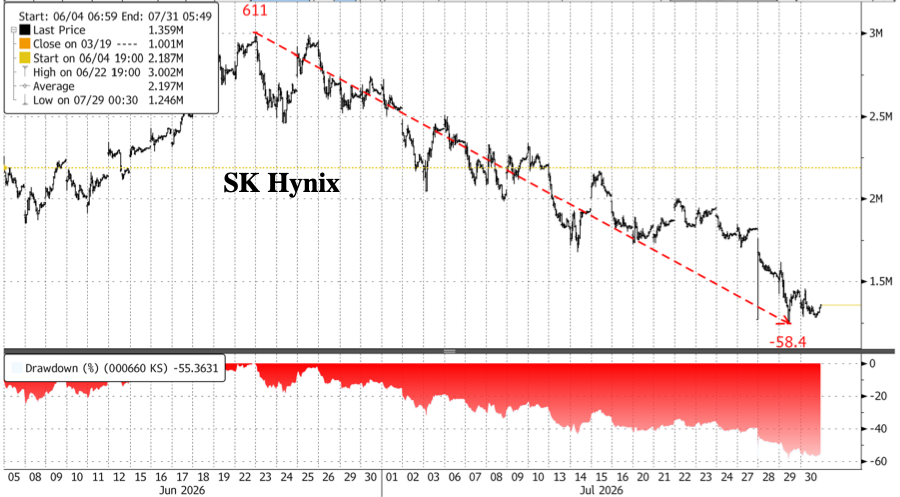
South Korean market authorities are weighing a more aggressive plan to stabilize the Kospi after July's record selloff sent the main equity index slicing through its 50-, 100- and 200-day moving averages like butter.
At the center of the meltdown is retail participation in leveraged ETFs tied to Samsung Electronics and SK Hynix, which amplified the selloff and inflicted crushing losses on Korean households.
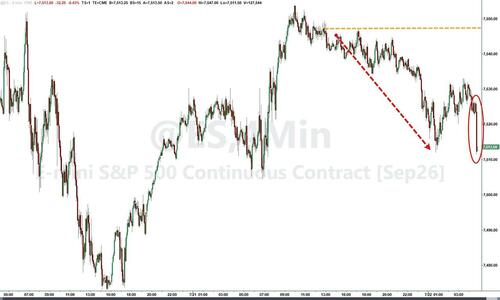
Korean trader had a $5 million stock portfolio ALL IN Samsung and Hynix.
— emini tic (@TicTocTick) July 29, 2026
It ended very badly.
Take a look. pic.twitter.com/dkqBZ9lMf8
Overnight trading in Asian equities struggled to find a proper floor as South Korean stocks kept volatility high and mom-and-pop retail traders horrified that their leveraged bets have been all but wiped out. The Kospi erased gains as much as 5.5%, closing down about 1% despite Samsung's confirmation of massive profits.
Bloomberg reports that as retail losses mount and public anger builds, there is political pressure on the government that encouraged households to participate in the AI stock mania of Samsung Electronics and SK Hynix.
"This is a headwind for a government that actively encouraged retail participation," said James Fletcher, CIO of Ethos Investment Management.
Fletcher noted, "When you nudge households into the market, and then they take losses of this size in 48 hours, the political pressure to do something becomes intense."
According to Bloomberg, South Korean authorities have five potential levers to arrest the market rout:
National Funds
The government has earmarked about 10 trillion won ($6.9 billion) to stabilize the stock market in times of turmoil. The rarely used tool resurfaced in analysts' minds after retail investor backlash grew over hefty losses. Its possible use was floated in late 2024, following a botched martial law declaration and during the Covid pandemic, but the last actual deployment dates back to 2008.
But tapping it may risk moral hazard, said Francis Tan, Asia chief strategist at Indosuez Wealth Management in Singapore. "Retail investors' call for the government to step in is a tricky situation," Tan said. "While the Korean government can always come in with a stock stabilization fund to provide targeted liquidity and help restore confidence, it risks distorting market signals."
The National Pension Service, one of the world's largest pension funds, often works with the government. But Choi HyunJae, head of equity research at Yuanta Securities Korea, doubts NPS will be actively involved in the current situation as "it's already well above its strategic domestic equity allocation target."
Short-Selling Ban
A short-selling ban, a controversial measure that was lifted in Korea last year after global investor outcry, may be considered again, said Jung In Yun, chief executive officer at Fibonacci Asset Management.
"But I would view that as a last resort because it may damage foreign investor confidence without addressing the underlying concerns," Yun said. "Their priority should be preventing a market correction from turning into a liquidity event."
Limiting Leveraged ETFs
Some investors and lawmakers are urging the delisting of leveraged exchange-traded funds tied to Samsung Electronics Co. and SK Hynix Inc., products introduced in May to magnify the underlying stock's gains and losses. One investor group even laid wreaths at the National Assembly gates, while an opposition lawmaker backed the call.
Retail investors buying leveraged ETFs drive volatility higher, while forcing foreign funds to respond with heavy selling, Young Jae Lee, senior investment manager at Pictet Asset Management in London, said. "It's a lose‑lose game" for retail investors, Lee said.
Korea's top market regulator has expressed "regret" over the rollout, but delisting existing ETFs appears unlikely for now. Instead, authorities have temporarily banned new listings, capped investor exposure and raised trading costs.
Brokerage Margin Requirements
Retail investors' heavy borrowing to buy stocks — and forced selling when prices fall — has worsened volatility. The government may consider stricter margin requirements, Tan said, also noting Singapore's push for stronger investor education.
While any tighter rules can curb margin growth, also important is to ease the mechanical selling pressure as accounts face forced liquidation. One way to counter that would be brokers easing collateral demands or give short grace periods before forcing liquidation, Choi said. Yet any relief would expose brokerages to greater risk and potentially cut their margin-related income, he added.
Share Buyback Rules
The government could also adjust share-buyback rules to spur purchases, especially from firms that already announced repurchase plans and see their stocks as undervalued.
Companies now face caps on buybacks at any given time and must spread purchases across a pre-disclosed schedule.
It is increasingly likely that the government will have to pull one or more of these levers to stabilize the market or risk a political backlash, particularly after encouraging retail participation in the AI and memory-chip bubble while mom-and-pop traders piled into leveraged ETFs.
The Financial Times reported Thursday morning on the scale of the losses suffered by households:
The brokerage Korea Investment & Securities said on Wednesday that nearly half of its 880,000 clients who bought Samsung shares were now sitting on losses, while nearly 70 per cent of its 408,000 investors in SK Hynix were also in the red.t will have to pull one or more of these levers to stabilize the market or risk a political backlash, particularly after actively encouraging retail participation in the AI and memory-chip boom while mom-and-pop traders piled into leveraged ETFs.
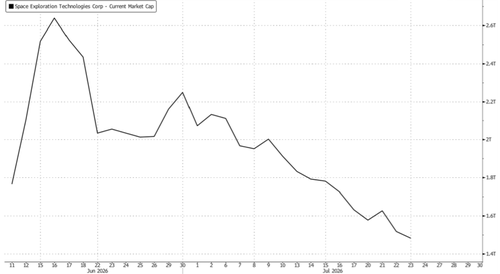
South Korea's Kospi collapsed nearly -40% in 40 days erasing -$2 trillion in market cap: (BBG)
— zerohedge (@zerohedge) July 30, 2026
The catastrophic effects of the massive retail leverage chase used to get here will only now start emerging. https://t.co/UpiauC8KMt
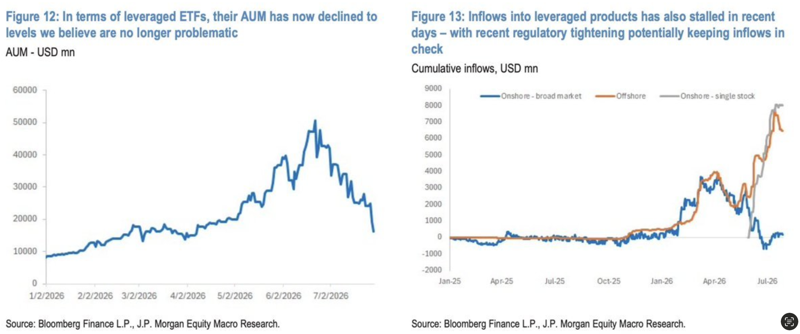
JPMorgan's chart below shows the leverage unwind has already been severe. Assets in leveraged ETFs surged from less than $10 billion at the start of 2026 to more than $50 billion in June, before collapsing to roughly $16 billion by late July, a decline of nearly 70% from the peak.
Latest coverage:
The good news is that inflows have also stalled or reversed, particularly in broad-market products, as the selloff and tighter regulation curb retail demand.
This suggests market stability may be returning and the risk of further leverage-amplified drawdowns has possibly diminished, though traders should remain on guard for renewed volatility.