Update (1630ET): After the bell, NVDA confirmed the earlier reporting (that it has signed agreements with six of the largest finance houses on Wall Street to mobilize a $500 billion package to fund the artificial intelligence infrastructure build-out), with a press release quoting each of the BSDs involved in depth.
“NVIDIA has reached an important milestone. We began by building chips; today, we are helping create a new class of productive, investable infrastructure: AI factories,” said Jensen Huang, founder and CEO of NVIDIA. “In AI, compute is revenue. NVIDIA compute is uniquely suited for this role. It is broadly adopted, flexible across models and workloads, fungible and transferable across customers and operators, and continuously improved through CUDA software — extending its useful life and improving its economics over time. It is supported by a deep global ecosystem of developers, customers and offtakers. That is why we are bringing the world’s leading long-term capital providers together to independently underwrite AI infrastructure. These financing platforms will help customers access scarce compute at scale and build the AI factories that will power every industry and country in the age of AI.”
“Modern compute has emerged as a scarce, mission-critical asset class with compelling investment characteristics that is positioned to drive significant long-term economic growth and productivity gains,” said Apollo President Jim Zelter. “The combination of NVIDIA’s proprietary technology ecosystem and Apollo’s flexible, long-term capital base provides a strong foundation to support the next stage of the AI buildout as part of the broader Global Industrial Renaissance.”
“The AI buildout will require unprecedented investment and a skilled workforce to turn that investment into the infrastructure that will help power future growth,” said Larry Fink, Chairman and CEO of BlackRock. “This partnership deepens our relationship with NVIDIA, including through the AI Infrastructure Partnership, and brings together NVIDIA’s leadership in accelerated computing with BlackRock’s ability to connect long-term capital to essential infrastructure. Together, we can help deliver the compute capacity that companies need to grow and create more jobs, supporting the continued growth of the U.S. and global economies, while creating attractive, long-term investment opportunities for our clients.”
“NVIDIA has created extraordinary demand for its compute through an intense focus on customer value and versatile technology,” said Jon Gray, President and COO of Blackstone. “We continue to be enormous investors globally across the NVIDIA ecosystem, and this announcement further underscores our confidence in their platform and the future of AI infrastructure.”
“As our strategic partner, NVIDIA is enabling us to scale AI factories. We are excited about further collaboration to build and fund the backbone of AI globally,” said Bruce Flatt, CEO of Brookfield. “With demand for large-scale AI compute growing significantly as adoption scales across industries, compute is fast becoming the essential layer of infrastructure and a core pillar of the Brookfield AI infrastructure strategy.”
“We’re in a pivotal moment of a historic AI investment cycle. NVIDIA’s full-stack platform is in high demand and uniquely positioned at the center of that global buildout,” said David Solomon, Chairman and CEO of Goldman Sachs. “Our investment and distribution roles reflect our confidence in NVIDIA’s leadership, and we’re excited for the new opportunity to create a market for credit backed by NVIDIA compute."
“Compute has become a critical infrastructure asset. As we’ve scaled our approach to digital infrastructure, we’ve learned that delivery, not ambition, is the hard part. That’s why we’re excited to build on our strategic partnership with NVIDIA, a founding investor in Helix Digital Infrastructure, to bring together NVIDIA’s accelerated computing platform with KKR’s long-duration capital, infrastructure expertise and capital markets capabilities to turn growing demand into real capacity at extraordinary scale,” said Joe Bae and Scott Nuttall, Co-Chief Executive Officers of KKR.
But, you know this debt raise is urgent when the heads of all involved head to CNBC for a roundtable to discuss why "we need to raise more money as fast as possible"...
🤯🤯🤯
— Nicholas Mugalli (@RealNickMugalli) August 10, 2026
“We need to raise more money as fast as possible”
“We’re going to need to spend trillions and trillion of dollars on compute”
Oh my goodness. We did not even start…government funding is coming too. you’re bearish?? https://t.co/ADlrS88ex1 pic.twitter.com/YAcmno6NRr
...because "we’re going to need to spend trillions and trillion of dollars on compute"...
Hear it from the Horse’s mouth. Jensen talking about the trillions of dollars going into compute. Whoaaa https://t.co/pXAfYbRViD pic.twitter.com/pgsG5YknpC
— Nicholas Mugalli (@RealNickMugalli) August 10, 2026
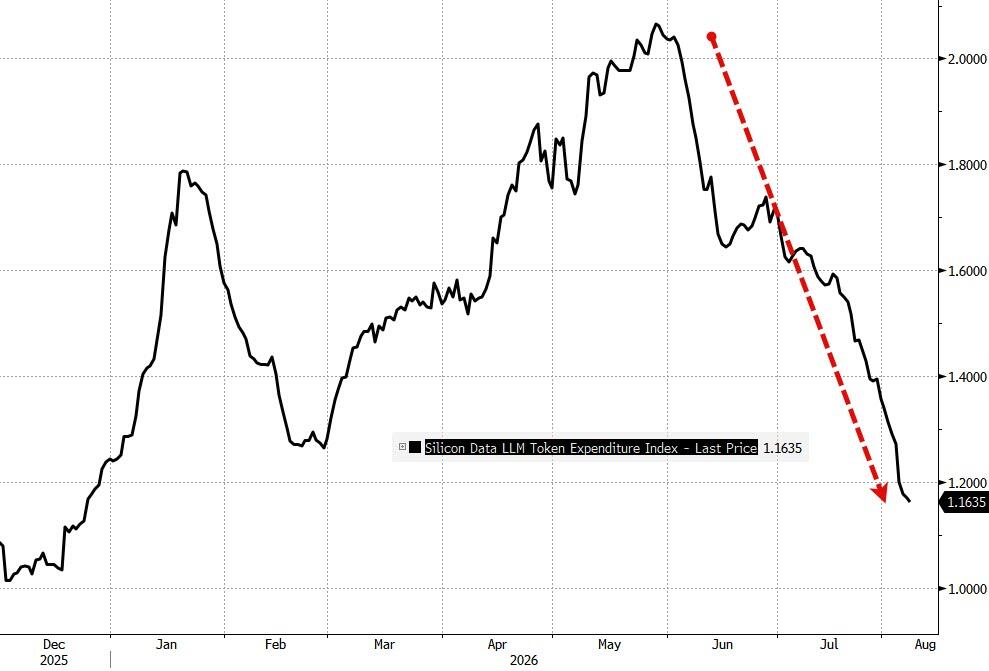
...presumably to compete with the Chinese as overall Token spend plummets...
* * *
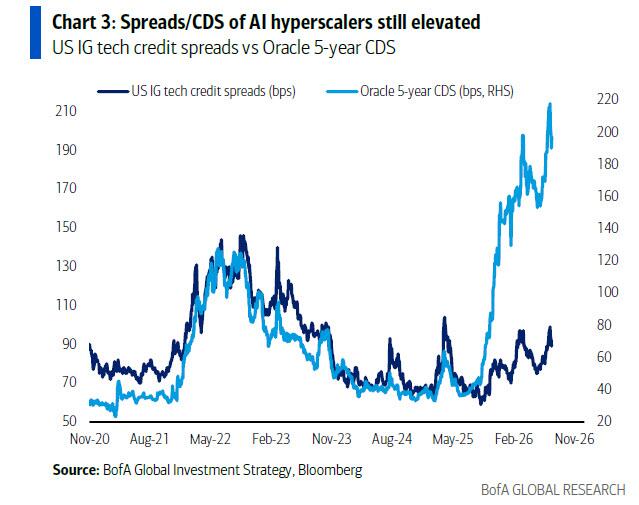
In what is shaping up as a record-breaking, off-balance sheet SPV deal, one which will send CDS and credit yields surging far beyond where the recent explosion in AI debt has already pushed them, and as shown in the chart below, it's pretty, pretty far...
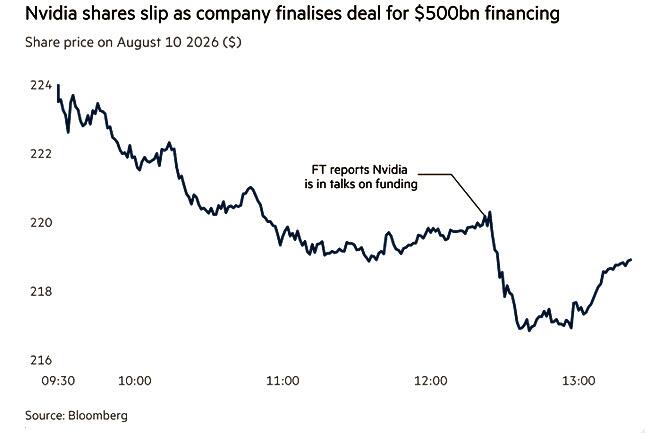
... the FT reports that Nvidia - unable to generate fund the old-fashioned way by earnings - is working with the world’s largest financial groups are to assemble a $500bn funding package for AI infrastructure development, in what will be the biggest AI lending efforts to date of any kind.
A consortium of groups including private credit (and equity) giants Apollo, Blackstone, BlackRock, Brookfield, Goldman and KKR is entering a partnership with Nvidia to invest in the AI build-out, the FT cited six people briefed on the talks.
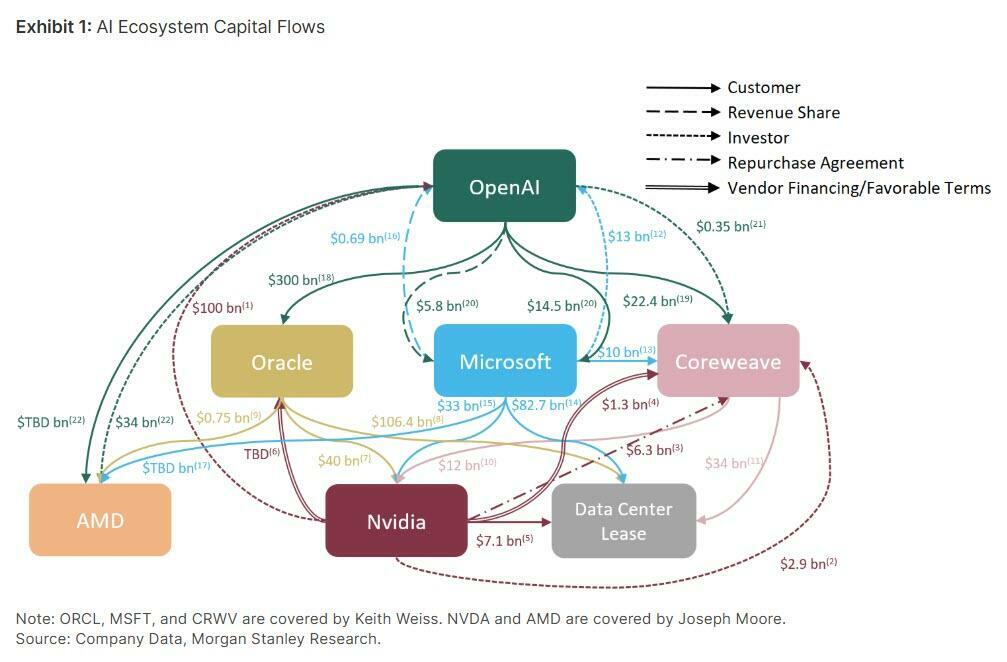
The "partnership" as the FT calls it as it sounds a bit better than "hail-may, off-balance sheet arrangement" underscores Nvidia’s increasingly desperate efforts to raise capital for itself and its clients (because everyone now admits that circular financing is absolutely critical to keeping the AI bubble going) to continue assembling the chips, power production and data centers at the heart of the AI boom.
The $5.25tn company, whose GPUs underpin most of the leading US AI models available today, has positioned itself at the center of the AI boom, providing chips, infrastructure and software to a wide array of partners developing the technology.
More ominously, as it brings back fresh memories of the vendor financing that was in part responsible for the collapse of the dot com bubble, the chipmaker traditionally provides financial backing to help its AI partners raise debt in capital markets, which then helps boost Nvidia’s own revenue, in what has become AI's trademark circle jerk deal.
As we have discussed here for the past year, the circular nature of such transactions has raised concerns about concentrated risks in the sector, and it's why NVDA stock slumped immediately after the FT news broke, sliding as much as 2% on the FT report and wiping out more than $70bn in market capitalisation.
Separately, Nvidia was in talks to provide a massive guarantee for a 10-gigawatt data centre project in Ohio leased to OpenAI, according to a person familiar with the matter.
The deal shows how Nvidia is building relationships with the giants of the private capital industry, which are collectively preparing to invest trillions of dollars of their insurance, retail and institutional investor assets into AI infrastructure.
In recent years, private capital groups such as Apollo and Blackstone have structured off-balance sheet SPV, pardon, AI infrastructure deals to assist companies like Anthropic finance their heavy spending on chips and data centers. We discussed this extensively two months ago in "The $1.8 Trillion Off-Balance Sheet Time Bomb At The Heart Of The AI Supercycle", a topic which the FT also caught up with today.
The US hyperscalers have now signed up for about $1 trillion of lease commitments that don't appear in their financial data (and are on the hook for another $1 trillion of future purchase commitments). https://t.co/hLnjMGUHzJ pic.twitter.com/Tx2zRfwnIW
— Robin Wigglesworth (@RobinWigg) August 10, 2026
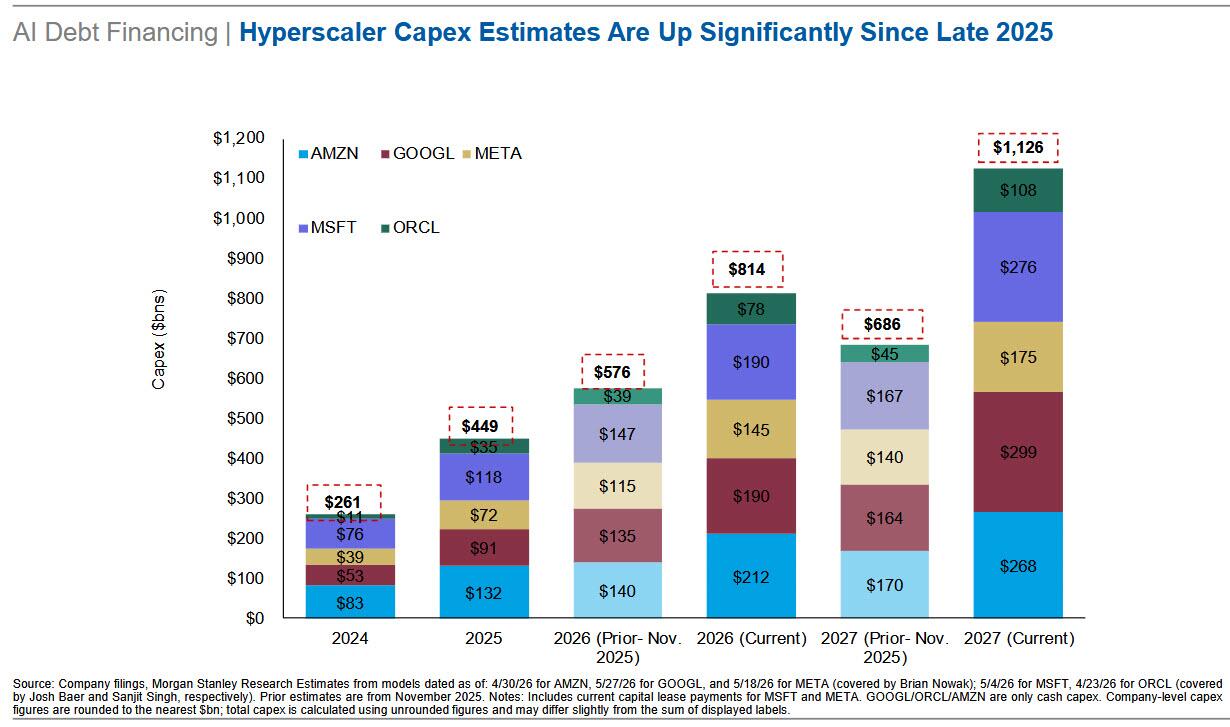
Nvidia, whose market cap has grown 15x since the launch of the first chatGPT in November 2022, is not the only beneficiary of the gargantuan circle-jerk deals that define the AI bubble: the biggest cloud-computing companies, including Meta, Oracle, Microsoft, Alphabet and Amazon, have also dramatically increased their spending on AI infrastructure as they look to win the race to dominate the emerging technology. Morgan Stanley projects so-called hyperscalers will spend $3.5tn between 2026 and 2028.
That need for capital has forced technology groups to tap every source of cash they can find, including public equity, investment-grade and high-yield bonds, securitised debt, private credit and project finance markets.
“[The] sheer size of the AI infrastructure build-out is unprecedented,” Jim Zelter, president of Apollo, said on an earnings call earlier this month. “More than $8tn of capital is expected to be invested, a staggering sum. We see an enormous opportunity for private capital to finance a portion of this along with public capital.”
While all that is great, it appears nobody has done the math on what happens if traditional, expensive frontier models lose to vastly cheaper, open-weight/source models. One thing is certain: the free cash flow hockeystick projected in the chart below will never, ever happen should open-weight models win the arms race.
So, uh, guys we still hockeystick FCF with everyone moving to open models? https://t.co/1i1Hs0XZIx
— zerohedge (@zerohedge) August 10, 2026
And now we sit back and wait to see just how far into the stratosphere this record SPV deal will send hyperscaler CDS and bond spreads.











































































































.jpg?branch=production)






























































































.jpg?branch=production)



































.jpg?branch=production)

















































.png?branch=production)


















































































![[VIDEO]: Alfred Edmond Jr. Enters The Chat On Support For Black Media](https://blackenterprise-prod.b-cdn.net/wp-content/blogs.dir/1/files/2024/09/pexels-mdsnmdsnmdsn-15778823-1024x682.jpg)



























































![POWER Digest [August 2026]](https://media.zenfs.com/en/power_magazine_984/9afa8c7842ccb40cf56437667d6b20d5)