Authored by Steve Watson via Modernity.news,
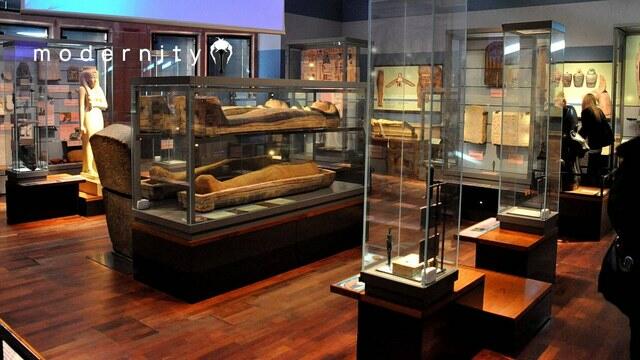
A Glasgow museum has pulled Egyptian mummies and other human remains from public view because the long-dead never provided "informed consent" to be displayed.
Yes, really, they've been moved to storage because the 5,000 year old people didn't say it was OK to display their remains.
The decision at Kelvingrove Art Gallery and Museum follows a draft Human Remains Policy from Glasgow Life, the SNP-funded body that runs the venue, which insists remains should only appear if there is "documented and informed consent from the deceased individual or, in appropriate circumstances, their descendants."
'How absolutely insane.'
— GB News (@GBNEWS) October 22, 2026
GB News' Will Kingston discusses a 'woke madness' debate that has arisen over the removal of mummies on display at a Scottish museum because they cannot give 'informed consent'. https://t.co/LnCYuZTS6V
Visitors found a sign where a painted coffin containing the remains of the priest Nekht once stood: "We have removed human remains from this display as a mark of respect." Also gone are a mummified male head, a mummified right hand recovered from the Valley of the Kings in Luxor, and a mummified right foot.
The artefacts range from roughly 2,000 to 5,000 years old. Glasgow Life says the change "reflects contemporary museum practice" and cites the International Council of Museums' revised Code of Ethics from June 2026, which calls on museums to "uphold the inherent dignity of human remains and promote respect for their significance."
It also references a 2025 All-Party Parliamentary Group on Afrikan Reparations report raising ethical concerns about displaying ancient Egyptian remains.
Of course, the reparations crowd had to be somehow involved.
A Glasgow Life spokesman stated: "In the absence of such consent, we believe removing ancient Egyptian human remains from display is more respectful to the deceased individuals."
The organisation is also removing archaeological human remains from the History Discovery Centre and the Scotland's Early People gallery at Kelvingrove, with further removals planned at St Mungo Museum.
What's next? Removing Neanderthals from the Neanderthal museum because they never signed a waiver?
Scottish Conservative MSP Murdo Fraser called the move "woke madness at its most ridiculous." He said: "Even Egyptian mummies are now being cancelled by a society so obsessed with modern sensibilities that it has lost all sense of perspective."
"People visit museums to learn about ancient civilisations, not to see history hidden away because it fails to meet today's ideological standards," he added, noting that Glasgow's museums "should be showcasing our history, not quietly removing it to appease the latest trend in political correctness."
Chris McGovern, chairman of the Campaign for Real Education and a former adviser to the Policy Unit at 10 Downing Street, described it as "more virtue-signalling, woke nonsense" and "the triumph of educational stupidity and ignorance." He noted: "It is not possible to seek permission from those who died thousands of years ago." He suggested Scottish authorities take their lead from Egyptian museums that "respectfully display human remains."
One visitor, Jonny McFarlane, brought his daughter to the ancient Egypt display after she had been "quite animated" by a book on the subject, only to find the exhibits replaced by the respect sign.
This is not an isolated episode of museums subordinating public education and historical display to contemporary ideological preferences. London institutions have repeatedly altered or obscured exhibits under similar rationales.
In March, London Museum Docklands half-covered a large early 19th-century portrait of Beeston Long, a former Bank of England governor who held investments in Jamaican plantations worked by slave labour, with multicoloured Madras cloth.
The exhibition trail "Caribbean Voices: Shaping Docklands" aimed to "reclaim the histories of colonised Caribbean nations" and celebrate the Windrush Generation's influence.
Information panels stated that artworks which might "obscure" or "sanitise" connections to slavery can "evoke emotional responses" and that museums should give a "voice to those whose cultures have been impacted by colonialism."
Some Caribbean partners reportedly felt "bitter and provoked" or "angry, furious and violated" by the uncovered painting. The cloth, historically exported to the Caribbean, was presented as representing Caribbean nations. A statue of slave trader Robert Milligan had already been removed from outside the museum in 2020 and placed in storage.
In Januar, the Young V&A in Bethnal Green placed books featuring graphic nudity and contested LGBTQ+ material in its children's reading room alongside titles such as The Gruffalo. It Isn't Rude To Be Nude displayed drawings of naked adults with exposed genitalia and captions including "willies aren't silly," with the cover declaring "contains nakedness - and that's OK!"
Another title, Rainbow Revolutionaries, included a glossary defining "gender affirmation surgery," "polyamorous," and "asexual" for young readers.
Parents described the selection as "pornographic," "a useful tool for paedos to groom children," and "psychological warfare." One said an essential part of safeguarding is to alert adults when strangers discuss intimate areas, "never mind actually showing them to kids."
Kate Barker of LGB Alliance called it "grooming in plain sight" and "an egregious safeguarding failure." Shadow equalities secretary Claire Coutinho noted the absurdity of banning children from wearing costumes while allowing material on polyamory and pansexuality. The V&A, chaired by Minouche Shafik and run by Sir Tristram Hunt, said staff had reviewed the books to ensure they were "age appropriate."
In December 2025, Brighton and Hove Museums published a blog post arguing that Santa Claus is "too white" and that his judgment of children as "naughty" or "nice" enforces colonial binaries and assumptions of cultural superiority.
The post suggested challenging the binary, recasting Santa in diverse forms including multiple Santas or "Mother Christmases," and prioritising cultural exchange over judgment.
Toby Young of the Free Speech Union called the museum "po-faced" and asked whether non-Christian countries should leave notes saying "sorry, but this is a decolonised fireplace and white supremacists dressed in red aren't welcome."
Alka Sehgal Cuthbert of Don't Divide Us described the idea as "laughable" and "intellectually vacuous," accusing museums of seeking to "rupture our sense of belonging to a common past and culture." A museum spokesman said the post was intended to prompt reflection and discussion rather than prescribe views.
In April 2024, an LGBTQ audio guide at the Queen's House in Greenwich, produced by a drag performer as part of a "Fierce Queens" event and LGBTQ+ History Month programming, claimed Queen Charlotte, wife of King George III, was "the nation's first royal person of colour" and that "insecure white boys writing history" had omitted this due to "structural racism."
After backlash, the museum later stated the guide was "light-hearted entertainment" by performance artists and "was not 'fact checked'." Critics noted Queen Charlotte was of German ancestry with no evidence of non-European heritage.
Former Royal Navy officer Chris Parry called the material "stupid," said it "degrades and defiles our national reputation for historical scholarship," and described the antics as "profoundly racist," calling for public funding to be removed.
In March 2024, Hastings Museum and Art Gallery, in association with the Hastings Queer History Collective and funded by Arts Council England, claimed that some birds are "queer" because female pheasants supposedly change sex after they stop laying eggs and develop male-coloured feathers.
The pamphlet stated that "queer behaviour in the animal kingdom" had been "ignored or hidden from the public" since the 18th century and that "with queerness visible in the natural world, the argument that it is somehow 'unnatural' begins to unravel."
A fossilised dinosaur footprint was even said to have "queer history" because of the personal life of the boy who found it.
Biologist Dr Emma Hilton stated: "The only vertebrates that change sex are all fish. Birds do not change sex." She noted that older female animals can develop male features due to hormonal changes, "but we would not say that older women had changed sex if they have a bit of a moustache."
In January 2024, Madrid's Prado Museum reviewed thousands of painting descriptions and signs to remove terms such as "dwarf," "deformed," and "disabled" to align with Spanish disability legislation.
Descriptions of Velázquez works were altered, titles such as "Prince Felipe and the Dwarf, Miguel Soplillo" were shortened, and "Portrait of a Dwarf" became "Portrait of a Buffoon." The museum said it was listening to "political consensus" and revisiting signs that "now we find are out of step with the times."
Across these cases, publicly funded institutions have repeatedly prioritised contemporary ideological frameworks over the straightforward presentation of artefacts, art, and evidence.
Critics consistently describe the pattern as the subordination of history and education to political fashion.
Museums exist to show the past as it was, not as current sensitivities require it to appear. When they hide the dead, cover the portraits, rewrite the labels, and invent queer animals, they stop being museums and become something else entirely.