
The Great Wealth Transfer from baby boomers to millennials and other younger generations involves much more than the junk in the attic, jewelry, and whatever else boomers collected or cherished. It sometimes includes a garage full of classic cars that younger generations seem to have little interest in, whether because tastes have changed or because they don't have the money to collect them.
Auto blog Carscoopsreports that 12 million collector cars worth $570 billion could pass to the next generation over the next 15 years. In total, there are more than 43 million collectible vehicles across the US.
Classic-car dealer Bob Evans Classics in Hulmeville, Pennsylvania, warned on Instagram last week that there is a "major shift in the classic car market."
Evans pointed out that "80s and 90s cars are skyrocketing in popularity and value, while many 60s and 70s classics are remaining flat."
He explained why: "The reason is simple. Millennials are becoming the next generation of serious collectors, while Baby Boomers are aging out of the market. People buy what they grew up dreaming about, and the money is beginning to follow that nostalgia. This isn’t a temporary trend."
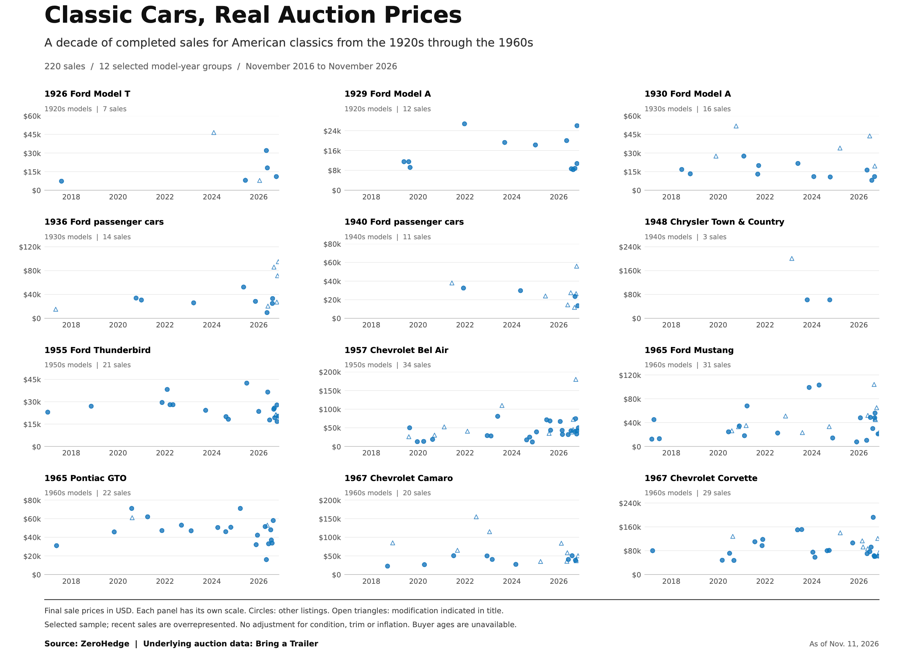
Our sample of 220 Bring a Trailer sale-price observations across 12 classic-car groups offers a snapshot of a portion of the classic car market, including Ford Model As and passenger cars from the 1920s and 1930s, as well as several models from the 1950s and 1960s. What we find is exactly what Evans was talking about: some of these classics from several generations ago have seen prices stagnate or even shift down.
"But these restored cars, such as the 1932 and 1934 Fords, the 1949 and 1950 Mercurys, the 1957 and 1955 Chevys, and the Bel Air, are plummeting. If you follow Barrett-Jackson auctions or others, you will find that there are many influencing factors," the YouTube channel Wranglerstar WarCamp recently noted.
Now, of course, there are exceptions, such as the Mercedes-Benz 300 SL gull-wing coupe, exotic Ferraris, and other blue-chip classics. But for less desirable models, amid the Great Wealth Transfer, downward pressure could extend to many of these inherited cars as they come up for sale at major auction houses such as Sotheby's, Barrett-Jackson, Mecum, and others.
And while everyone complains about how expensive new cars have become, with the average price around $50,000 in October, perhaps searching for a deeply discounted, restored classic could be one great idea. You'll probably save money on insurance and registration, but probably not on fuel economy. Maintenance, of course, could be another story, but the good news is these classics have no complicated systems and expensive chips.