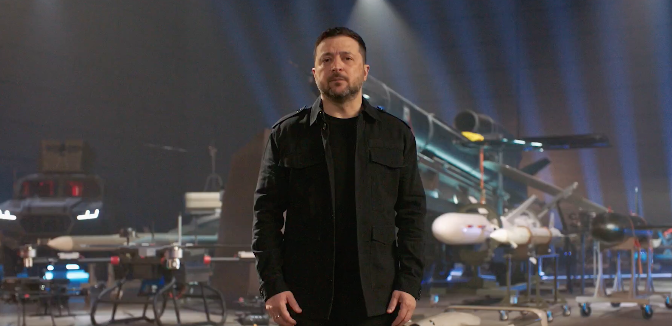
Ukrainian President Volodymyr Zelensky took the stage and stated that Ukraine's military-industrial base has created some of the world's most advanced unmanned platforms, already deployed against Russia and forever changing how warfare is conducted.
"For the first time in the history of this war, an enemy position was taken exclusively by unmanned platforms, ground systems, and drones," Zelensky said in a post on X.
The future is already on the front line – and Ukraine is building it. These are our ground robotic systems. For the first time in the history of this war, an enemy position was taken exclusively by unmanned platforms – ground systems and drones. The occupiers surrendered, and the… pic.twitter.com/qLQKfxPdiB
— Volodymyr Zelenskyy / Володимир Зеленський (@ZelenskyyUa) April 13, 2026
He pointed to a growing number of Ukrainian defense firms, including Ratel, TerMIT, Ardal, Rys, Zmiy, Protector, and Volia, claiming their robotic systems have carried out more than 22,000 frontline missions in just three months.
Zelensky's broader message seemed more like a PR pitch for Ukraine's defense firms, which are capable of producing millions of FPV drones annually, as well as deep-strike systems, interceptors, ground robots, and maritime drone boats.
‼️ ZELENSKYY: For the first time in the war, an enemy position was captured entirely by ground robotic systems and drones - without any infantry. A robot entered the most dangerous zones instead of a soldier and took the positions.
— Kateryna Lisunova (@KaterynaLis) April 13, 2026
«The future is here, on the battlefield, and… pic.twitter.com/maqECUunEj
"Ukraine's robots were sculpted by combat. I've seen the video footage of their UGVs taking hostages. This is what future battles will look like," Foundation Robotics co-founder Mike LeBlanc said in a statement.
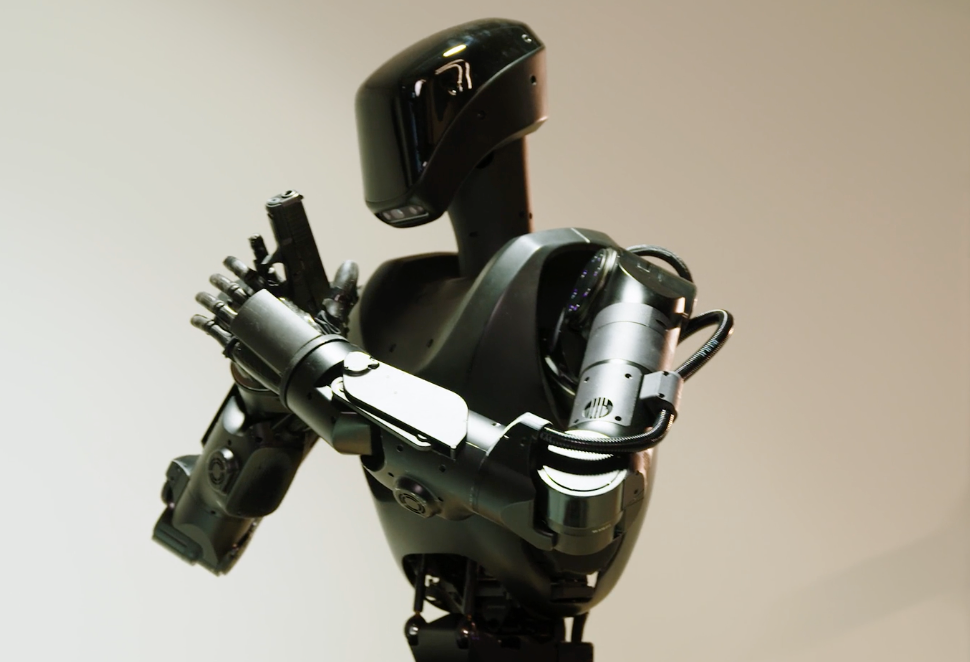
LeBlanc's team is preparing its Phantom humanoid robots for testing and continues to develop militarized humanoid prototypes designed to operate alongside warfighters in high-risk environments.
In February, Foundation sent two Phantom MK1 robots to Ukraine for testing, according to a TIME Magazine article.
Ukraine's capital markets have been frozen by war, leaving many of the country's battlefield-proven "war unicorns" starved of traditional funding. However, the Middle East conflict has accelerated a new export pathway, as drone warfare and AI-enabled kill chains reshape how militaries think about defense.
Reuters has reported that Gulf states, including Saudi Arabia and the UAE, are exploring Ukrainian interceptor drones as a more affordable response to the emergence of Iranian one-way attack drones. At the same time, Ukrainian firms or their European subsidiaries are eyeing U.S. civilian and defense markets to sell their combat-tested systems. The first plausible path into the U.S. market appears to be through affordable counter-drone solutions and other layered air-defense technology.
Meanwhile, so-called "experts" cited by The Moscow Times called Zelensky's X posts "mainly a PR move," but highlighted how robots "are already transforming both tactics and strategy" in the four-year war.
Zelensky is correct: "The future is already on the front line.










































































































.png?branch=production&format=jpg&width=1024)