BMW shares cratered in Germany after the automaker warned investors it would slash its 2026 margin guidance to as low as 1%, down from a prior estimate of as high as 6%, amid weakening demand in China, Middle East-related pressures, rising energy costs, and a deteriorating consumer backdrop hitting sales and profitability.
BMW now expects its pretax profit to fall sharply this year, versus a prior expectation of a moderate decline, and for deliveries in the auto segment to slide, compared with a previous expectation of flat performance.
Here's the new forecast for the year:
-
Sees automotive Ebit margin 1% to 3%, saw 4% to 6%, estimate 4.9% (Bloomberg Consensus)
-
Sees Automotive return on capital employed 1% to 5%, saw 6% to 10%
JPMorgan analyst Jose Asumendi called the downgrade a major "wake-up call for the auto industry" and warned that the German luxury automaker must address its compact-segment product strategy in China, where European premium automakers have been priced out of the market.
Asumendi called the downgrade a "radical earnings cut" but noted that BMW is generally executing well. He believes the automaker will likely take one-time charges to downsize its global production footprint, with a particular focus on Europe.
Here is Barclays analyst Christophe Boulanger's first take on BMW's big profit warning:
BMW's profit warning signals a sharp cyclical and regional deterioration, with China and macro/geopolitical factors driving a reset in expectations. While management is addressing costs, near-term fundamentals look weak, with recovery deferred to subsequent years. We reiterate our UW rating.
FY26 outlook sharply downgraded amid China weakness, macro headwinds and restructuring
BMW issued a material profit warning for FY26 on the evening of 16 June, reflecting a sharp deterioration in China and a more challenging macro backdrop (two-thirds of the profit warning). The downgrade is broad-based across volumes, margins, cash generation, and returns, with further measures to adjust the cost base, including a restructuring provision (one-third of the profit warning). This one-off item is said to amortise within two years and not be cash effective in 2026 (indicating a combination of restructuring provisions and impairments). The company will disclose further information at its capital market day in September.
Overall/China market development has been weaker than expected by management at the start of the year. In December 2025, CPCA (Chinese Passenger Car Association) expected flat Chinese passenger car sales in 2026, but in May cut its estimate to -7.6%, then -11%, and to -14.1% on 16 June, versus YTD May actuals of -19.4% for the total market.
New FY26 guidance: Auto deliveries to decline 1-5% (from flat in previous guidance), Auto EBIT margin to range between 1-3% (from 4-6% in previous guidance and 5.3% FY 25), a >15% decline in group PBT (from a 10-15% decline in previous guidance) and FCF to >€2.5bn (from >€4.5bn and €3.24bn in FY25).
Read-across to other OEMs: We view Mercedes as the major OEM on the cross-read (c.50-60% China EBIT exposure vs BMW c.50%). VW is much less exposed at c.20%. We see no meaningful read-across for STLA, RNO.
As stated in our Euroean IG Best Ideas report, 17 June, our Underweight rating on BMW (and Mercedes) is driven by tight valuations versus the peer group (as stated in recent our recent report that highlighted downside risk) and weak FY26 guidance and fundamental outlook.
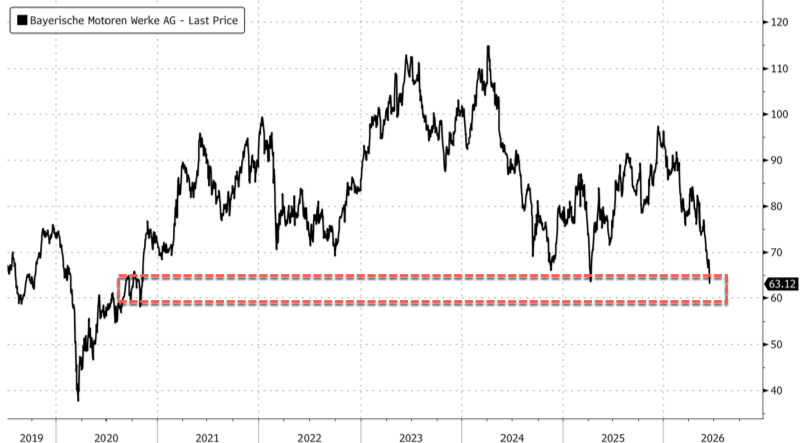
Shares of BMW in Germany tumbled as much as 12%, the biggest intraday decline in almost two years. For the year, shares are down around 32%.
Shares are trading at Covid lows ...
Citigroup analyst Harald Hendriks explained to clients why his team remains "Neutral" rated on BMW shares:
Conclusion — Yesterday's announcement confirms investor concerns over the sustainability of BMW's China business. While the profit warning helps bring down earnings expectations, the real question is what other way can BMW reliably boost EPS growth and finally build a "momentum" equity narrative? With no obvious positive equity narrative, with FY26E earnings still under downward pressure, with a structural thematic negative industry trend, with continued industry-punishing EU regulations, and with a limited number of investors in European (German) value names, we think BMW's undervaluation may persist. Given we see no new positive catalysts at BMW, we maintain our Neutral rating.
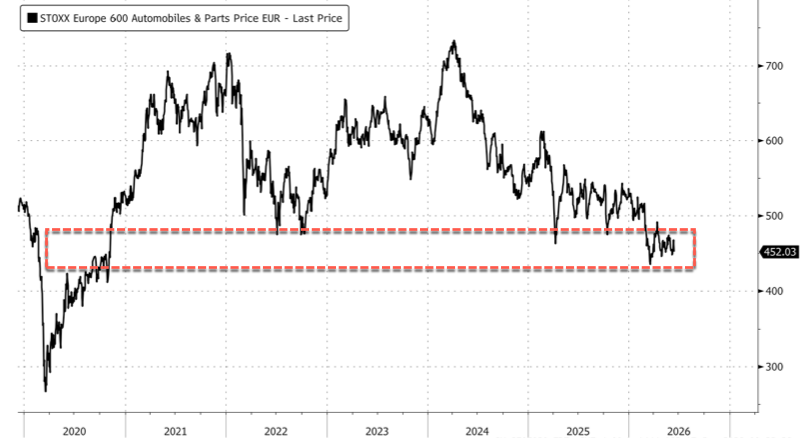
As for the STXE 600 Auto & Parts Index (which includes names such as BMW, Mercedes-Benz, Volkswagen, Stellantis, Porsche, Ferrari, Renault, Continental, Michelin, Valeo, and others), Europe's auto industry has drifted back to 2020 levels.
Europe's left-wing political elites may want to rethink their strategy of allowing low-cost Chinese EVs to flood the continent before the region's industrial base suffers lasting damage. BMW's warning suggests the turmoil is industry-wide and likely spread across the broader European manufacturing complex. Also, climate policies on the struggling continent have been an utter disaster.









































































































































































.png?branch=production)






































































































































































.jpg?branch=production)