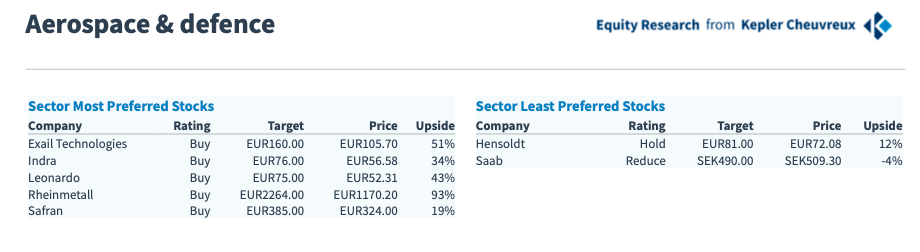
One of the world's largest defense and security trade shows is wrapping up this week near Paris at the Paris Nord Villepinte exhibition center, where equity analysts from Paris-based Kepler Cheuvreux attended the event.
Eurosatory focuses mostly on land and air-to-land warfare, including tanks, armored vehicles, artillery, drones, counter-drone systems, missiles, air defense, communications, battlefield software, logistics, robotics, military medicine, and homeland security systems.
Fire Point updates their Eurosatory stand this morning. #Ukraine pic.twitter.com/2RwlJlh8fW
— Peter Voinovich (@PeterVoinovich) June 18, 2026
Kepler Cheuvreux equity analyst Aymeric Poulain attended the event and spoke with top executives from European defense giants Thales, Exosens, Leonardo, Hensoldt, and Rheinmetall. He also met with Safran executives at the company's headquarters.
Les guerres d’aujourd’hui ne se gagnent pas sans drones.
— Marion Maréchal (@MarionMarechal) June 17, 2026
Au salon de l’armement Eurosatory, j’ai eu le plaisir d’échanger avec les ingénieurs d’@EOStechnologie, qui produit à Varces (Isère) des drones et munitions téléopérées de qualité exceptionnelle.
Fière de ce… pic.twitter.com/oNxl4PfDpi
Poulain penned a note on Thursday titled "Game of Drone," in which he was able to "take the pulse of the sector" to determine the "latest product trends."
A german-made logistics only (for now) drone on KNDS stand at #Eurosatory. pic.twitter.com/YQS3NhRusx
— Elisabeth Gosselin-Malo (@elisabethmalom1) June 17, 2026
He said European defense sentiment remains firmly bullish, with Eurosatory underscoring enthusiasm among investors and industry interest in drones, counter-drone systems, missiles, lasers, and unmanned platforms.
The war in Ukraine and the conflict in the Middle East have accelerated this defense shift, demonstrating how low-cost drones, autonomous systems, and robotic platforms are increasingly dominating the modern battlefield and forcing legacy defense primes to adapt their portfolios at lightning speed.
Poulain's summary of what he saw at the defense show:
1. We accompanied a group of investors at the Eurosatory trade show for the defence and security industry in Paris early this week. The show was an occasion to meet with Thales, Exosens, Leonardo, Hensoldt and Rheinmetall and take the pulse of the sector and the latest product trends. We also met Safran at their headquarters. This always proposes a sample of our notes from the visit.
2. The atmosphere was buoyant amidst booming times for European defence. One of the most striking features of the show was the prominent display of drones and counter-drones, both as an add-on to incumbent core portfolios or as the core product for defence tech players. The Ukraine delegation came in force this year (even as the country is not allowed to export its production yet), underlining the significant use of drones and unmanned equipment, including underwater unmanned systems, in combat operations in the country. We talked to one of the association's representatives and were shocked to hear that production, which was 2m last year and was expected to reach 4m this year, is actually on track to reach 7m by the end of the year! It is no wonder, therefore, that the so-called "kill zone" has widened from 5km at the beginning of the war to 50km by now and that the "kill rate" is now averaging 400K Russian troops per year, a staggering demonstration of the law of large numbers. Ukraine has banned exports, such that its entire stock of weapons is aimed at supporting the war effort, but a strong presence at the salon shows that Ukrainian arm m
3. The presence of drones, missiles and counter-drones solutions was ubiquitous, be it as a new add-on to incumbent platforms and kits or as a hardware derivative of defence tech players (such as Shield AI, Harmattan AI, Destinus, Quantum Systems or Helsing). The use of laser solutions (e.g., EOS) to neutralise drones or satellites was another demonstration of how science is now turning fiction into reality and how every incumbent is adapting their portfolios to the unassailable and rapid evolution of technology and modern warfare
Key summaries of Poulain's conversation with top executives from top EU defense firms:
Thales
• At Thales, we met the head of North America and Louis Igonet, head of IR. As the trade show is mostly dedicated to land-based solutions, our visit was an occasion to discuss the exposure of Thales to this field, including Thales' integrated command & centre solutions, drone and counter-drone products, as well as electronic warfare capabilities (high energy microwave solutions).
• Air defence is on top of the agenda when it comes to defending Europe, including radars, integrated multi-domain modular command & control solutions (SkyDefender), secured communications, missiles, etc. Thales is not as exposed to effectors as other defense companies, but is well positioned to gain in counter-drone with low-cost effector solutions to neutralize drones. The evolution of the battlefield has seen the ascent of drone warfare and defence tech. Thales believes its AI and sensor capabilities give it a license to operate in this highly competitive segment. The deal announced with Renault to join forces to manufacture 1000 Toutatis drones per month was announced just before the show. At USD 30K per unit, the drone's accuracy is said to rival cheaper drones (at USD 1000 per unit) whose swarms may need 20-50 units to hit. The group noted that anti-tank missile demand is shrinking, but overall demand for missiles is growing. Thales is an equipment supplier to platforms and is therefore platform agnostic and indifferent about the future of armoured vehicle platforms. Whether it is unmanned or manned, the group is selling the same growing amount of sensors and radars, while it is also increasing its share of low-cost munitions. Thales is exposed to the Patriot missile as a supplier of seekers to Boeing and expects a 3-4x increase in demand from this customer. This is on top of its own anti-ballistic missile system, the SAMP/T NG, whose growth prospects are excellent and first export versions are expected to be delivered to Denmark from 2028E, hence the view that missile seekers could grow from a few hundred million euros to a billion-dollar business in the not-too-distant future. The group defined itself as a tech company given its giant EUR4bn+ R&D budget. Current priorities include Cybersecurity, AI and Quantum technologies. Some 1000 engineers are dedicated to applied AI to improve the prowess of its sensors and radars. Similarly, the group leadership in quantum technologies enables the creation of much more efficient and less power-hungry radar systems.
• Order intakes continue to be strong and above expectations with jumbo platform orders (SAMP/T NG and Rafale) expected this year, while much smaller orders (below EUR 10 m) still represent the bread and butter of the group. European orders dominate. Unsurprisingly, perhaps, as 65%+ of the group revenues come from the region, which also happens to be the most dynamic worldwide and benefit from lending facilities that promote European-made equipment buying. In Germany, the group is mostly exposed to the Maritime domain, having won the electronic lead role in the Frigate 126 programme, while it is also gaining ground on radars and communications, notably as part of Germany's EUR 11bn shipment of military goods to Ukraine. However, as a global Franco-British defence contractor, possible delays in the British budget are not seen as a major risk, especially as it should be more than offset by France's LPM EUR 36bn top-up plan, which parliament should vote on and sign soon. Thales is also hopeful to get a growing share of the growing Canadian pie, as the country is trying to reduce its reliance on the US. The group recently booked a EUR 400m (AUD750m) contract in Australia for 268 next-generation Bush Master vehicles. In the US, the group is a leader in communication and secured radio com (along with L3Harris), sonars (world leader), avionics (modest), missile electronics and optronics sensors. The ambition is to double the US business by 2030. Thales has been present in the Middle East for at least 50 years, such that the recent developments in the region are likely to be a positive for the company, which also assembles radar in the UAE. Some 10% of revenues stem from the region, and recent urgent operating requests suggest that orders in the coming year could boost growth.
• The group has also built capacity ahead of the demand, hence its capacity to deliver off-the-shelf, which has been behind its recent double-digit revenue growth momentum and should continue to support both record-breaking orders and revenue growth. Supply chain is performing well, even if the group continues to be vigilant on PCBs. In that regard, Thale is building its own internal capacity. Inflationary pressures in the memory space are covered by indexation clauses.
• M&A is always part of the capital allocation toolbox at Thales, although the group is clear that the goal is not to add a new leg to the portfolio and that it first needs to prove the merit of the Imperva acquisition (which we believe it will, as organic growth is set to recover as the year progresses in the key cybersecurity segment). The Space carve-out means that Space will be looking at its own acquisition as a deconsolidated JV, therefore focusing attention on defence and avionics. The Bromo merger talks are ongoing and focus on convincing social partners and anti trust authorities, while giving the time to Airbus to complete its own carve out. That said, the market opportunity for Space is growing amidst rising EU and ESA budgets.
Exosens
• We had a chance to meet Jerome Cerisier, CEO of Exosens and Laurent Sfaxi, head of IR, who showcased the latest innovations fuelling the group's strong organic growth at the moment.
• The group's infrared thermal imaging solutions (part of D&I) have been in high demand and a key driver of upgrades lately. The product includes both large high-ticket surveillance cameras (a few hundred sold per year at EUR 100K+ a unit) and smaller thermal sensors used in higher volumes by the drone industry (delivering batches of 10k unit orders), the group claiming a dozen clients in this field. Part of its success has been its presence in Europe (the main competitor is Teledyne) and its agile integrated solution. Scale is not an issue, and gross margins are comparable to Amplification.
• In Amplification, the group showcased its bread and butter 4G tubes (used by Theon's binocular NVS), sold at EUR 2400 per unit on average ("between EUR 2000 and EUR 3000) as well as its latest resolution 5G tubes, whose resolution is 35% better and price tag probably 20-25%+ better too. The group is on track to produce 6,000 5G tubes this year, with growth driven by yield improvements rather than additional capacity, in line with the existing plan to reach 175,000 tube capacity by 2028E.
• Geographically, Europe is where the highest growth can be seen, although the growing presence of Asian delegations on the show underlined the growing demand expected from countries such as Japan and Korea, the latter likely to be slower-moving than the former.
• Civil activities at D&I are also enjoying a turnaround of sorts. The semiconductor industry is booming, and demand for non- destructive wafer testing solutions should be benefiting. Life sciences remain complicated, but demand for nuclear gamma ray monitoring devices is starting to take off on the back of the growing interest for SMRs, notably in the US. The group is supplying half of the projects that have been selected in the US and sees "very, very strong growth" as a result, albeit for a low base, in a small niche market shared between Exosens and Mirion Technologies.
• M&A remains on the agenda, the group having commented that the size of its next deals could be bigger than in the past. Although multiples have definitely increased in defence, management has not seen a material inflation of multiples for civil dual- use tech application targets, as it tends to pursue.
Leonardo
• Our meeting with Leonardo was shortened and did not bring anything new to our understanding of the story, which was covered most diligently by Matteo Bonizzoni.
• Order intakes were a record EUR 9bn in Q1, which compares with a EUR 25bn guidance for the year. This included a big helicopter order from the UK (GBP1bn).
• Iveco's consolidation details will be provided in Q2.
• A new CEO took over. Aer 35 years at the company, he knows the business well and would effectively mark a continuation of the strategy set by his predecessor.
• A deal in Aerostructure is no longer realistic this summer.
• However, the group is confident in delivering on its guidance.
• The Middle East is 8% of revenues and growing. Leonardo expects strong demand to come from the region.
• The GCAP is difficult, given the ongoing funding constraints. Yet, it received its first international order. So the program is progressing even if not fully funded.
• The 22.8% stake in Hensoldt is currently looked at as an industrial partner. However, as it is clear that there is no chance for Leonardo of getting control, the group is discussing how to leverage the stake industrially at the moment, but could also eventually decide to realise the value of its stake through a financial sale if no synergies can be found
Hensoldt
• Hensoldt showcased its TRML 4D and Spexer radars, which are in high demand and currently expanding production with a view to doubling capacity from 15 in 2025, estimated at 20 in 2026, to 30 TRML 4D radars in 2027E.
• Although the group's revenues and order intakes are dominated by Germany and other NATO countries (10 Skyshield countries have opted for TRML 4D radars), the group would expect Middle East demand (a low single-digit percentage of group revenues) to double over time.
• Growth should be strong this year, while the book-to-bill of 1.5-2x highlights the strength of the current order momentum, but also the lumpiness necessitating quite a range of absolute outcomes (EUR3.8-5bn order). The group expects to receive EUR 1bn orders for new Pegasus surveillance aircra or Luwes jamming systems, whose exact timing remains uncertain.
• The end of the FCAS is not a concern to Hensoldt, which expects an alternative to the programme. Meanwhile, the group would expect to reallocate a third of the 150 engineers working on the project to other R&D priorities. Paid for R&D accounted for 15% of group revenues last year.
• The stock has derated on macro considerations and ceasefire concerns, but ramping up production to meet a fast-growing backlog of multi-domain sensors and optronics solutions secures the strong 15-20% top line growth outlook earmarked at the CMD last year.
Safran
• We met the Safran IR team at their headquarters aer our visit to Eurosatory.
• The company presented last week its Defence ambitions in Montlucon. We encourage our readers to refer to our site visit note for more details on the very strong prospects offered by Defence for Safran and the confidence we have in the group's ability to continue to surprise in its Propulsion Civil aermarket business, making the stock still one of our highest conviction ideas in the aerospace & defence sector.
• The group's defence portfolio contributed c.20% of revenues in 2025, of which half was attributable to Propulsion (or EUR3.1bn last year) and the rest to Equipment & Defence (or EUR 3.2bn last year).
• In the propulsion, some 10% of revenues stem from Military Engines, notably the M88 engine deliveries and aermarket revenues, whose delivery rates are set to double by 2029. This does not include the possibility of new Rafale orders; the group is awaiting the signature of the 114 Rafale jet Indian contract (FCF guidance not including such jumbo deals). Meanwhile, Safran Propulsion is benefiting from the booming missile demand (EUR0.4bn revenues), which already tripled between 22-25E but is on course to grow by 7x by 2028. Safran is on board 10 missile platforms (with MBDA, Kongsberg and Saab in particular) and is currently in discussion with US missile makers. Another 5% of the group's Propulsion revenues is directed at military Helicopters, whose business is heavily split between aermarket and new turbine deliveries. Margin-wise, the group is not commenting on the contribution by the sub-segment other than the fact that the growth in military propulsion is not expected to be dilutive to the propulsion margins.
• The group's defence segment in Equipment & Defence is enjoying very strong demand for its Hammer guiding kits, recently illustrated by a key ballistic missile win. Here, the group has seen demand grow 5-6 fold over the last three years with continued very strong momentum, hence investments to triple production. Order intakes grew by + 60% last year, pointing at least high teens growth for Safran Defence Electronics Defence segment by the end of the decade, from 17% CAGR reported between 22- 25E. 80% of the order book is international and platform agnostic, while the group is capable of covering the entire spectrum from highly sophisticated programs to more affordable mass customers. In Equipment & Defence, the outperformance of defence is set to be margin accretive and a key reason why management is confident it can increase margin to mid-teens.
• Outside defence, the equity story remains dominated by the group's core Civil Propulsion business, which accounts for 80% of its Propulsion business, of which 68% is narrow-body engines (CFM56 and LEAP), and 12% comes from wide-body. Growth in Civil Aermarket Propulsion was very strong in Q1, including 29% for Spares and 40% for Services. Growth in Spares was not driven by the growth of shop visits, although a growing portion of LEAP shop visits are done by third-party MRO (up from 10% to 15% of total, on 30% shop visit growth expected this year, suggesting a doubling of LEAP third-party spares demand). That said, the bulk of spares growth is explained by CFM56, whose shop visit growth is now flat and pricing gains amount to 5-7%, thereby highlighting the importance of workscope effects, which are growing faster in 26E than in 25E, a phenomenon that could prevail until the end of the decade in line with the ageing fleet and the growing number of 2nd shop visits that tend to consume 60% more parts than the first ones (albeit the average varying given the fact that some spare part replacements are mandatory while others are at the discretion of the airlines). Another for the 3rd shop visits that typically compete on price with the second material, they are also set to contribute more, as there is no stock of the second spare part and as power generation players now buy a growing number of retired engines. Retirement rates of CFM56 have been below the planned 2% this year (at c.1-1.5%) and could continue to be below the 3-4% expected in the coming years, as airlines have so far not changed their behaviour, probably on the assumption that the oil shock would be temporary. Safran has not seen slot cancellation or deferrals as companies do not want to be caught off guard should a reopening of the Hormuz Strait opens soon (likely if a deal is signed this week end in our view and as suggested by the sharp fall in oil prices) pointing to another strong quarter in Q2 and very strong confidence in delivering low teen CAGR in revenues and EBIT for Propulsion between 25-28E (at 22-24% margin), driven by CFM56 and LEAP . If growth offers visibility on the back of planned shop visits and pricing power, the margin band is mostly a reflection of mix question marks and the likely normalisation of spare engine ratios in the LEAP engine delivery mix (expected to be 10-12%). There is upside to margin, though, as tariffs paid last year may be refunded this year, although this may simply compensate other inflationary effects.
• Outside the sensitivity of airline traffic and balance sheet to the macro, Safran USD hedging stands at 1.13 until 2028E, such that the risks to group assumptions appear limited to the French corporate tax surcharge (assumed at EUR 475m this year and not recurring next year), although cash flow assumptions remain prudent as they do not assume the possibility for large order advance payments in defence.
• Divestments from Cabin are gathering pace, as the group is expecting stronger prices in Seats to boost revenues and profit margins in the coming year and beyond. Cabin has more limited upside and is set to rebound to HSD margin, hence the decision to exit. Divestment is complicated by AIFR's keenness to secure supply and therefore prefers industrial solutions.
How to profit:
Related but stateside:
- Congress Moves To Boost Drone Funding As "War Unicorns" See Possible Procurement Supercycle
-
JPM Call With Axon Reveals Race To Fortify U.S. Data Centers Against Kamikaze Drone Swarms
-
Goldman Sits Down With Anduril As 'War Unicorns' Reshape Defense Tech
-
"Flying Beer Cooler": Pentagon's Next Kamikaze Drone Ushers In Era Of Cheap Mass-Produced Airpower
Professional subscribers can read about drones, humanoids, and modern war tech reshaping battlefields at our new Marketdesk.ai portal.
















.jpg?branch=production)



































































































































































































































































.png?branch=production)




































































































































































.jpg?branch=production)