"The Mississippians are a massive civilization of millions of people who lived in the entire eastern United States," archaeologist Ed Barnhart told Shawn Ryan on the Shawn Ryan Show, in an episode released Thursday. "It was a full-blown civilization that we have kind of forgotten or ignored exists."
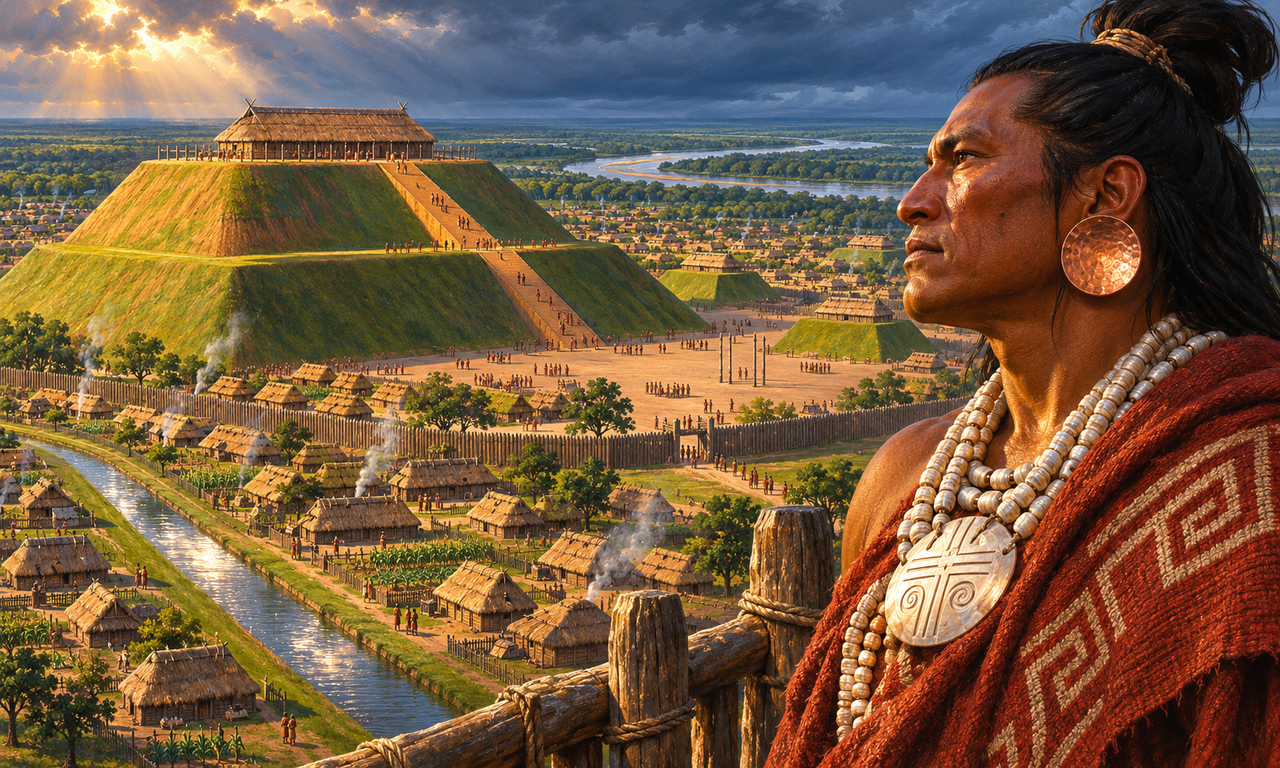
Barnhart, who founded the Maya Exploration Center and was back on the show after an earlier episode on the Maya, said the Mississippian world took off around 900 AD, built "on the shoulders of people who were already building things like pyramids." "Now they're building cities that have pyramids that are 100 feet tall," he said, with "hundreds of houses," walls, and "agricultural systems along the rivers, aqueducts, water management things."
He described the waterworks as "hydraulic engineering": water brought "through an aqueduct" from a river, so that "it goes into a reservoir inside the city, which then has channels that go to other parts of the city." Because none of it was stone, he argued, it gets written off. "If they're not built of stone, how can they be complex?"
"I'm Going To Call That Guy A King"
Archaeologists tend to call the rulers of these cities chiefs, Barnhart noted, but he doesn't. "We tend to call those guys chiefs right now. But, you know, a guy that sits up on top of a pyramid living in a palace over 20,000 people, I'm going to call that guy a king," he said. "That's a little beyond chieftain level."
In his telling, these were "independent city states that fought and killed each other," each run as a family business. He described "a very organized political system" with "kings and subcategories and workers at the bottom," able to coordinate building "a two-mile wall 20 feet tall or 10 feet tall." The king's relatives ran the outlying towns, "just like in Europe," and Hernando de Soto later exploited it, seizing a king's in-laws on the edge of a kingdom to get inside its walls.
Cahokia And Mound 72
The first and biggest city was Cahokia, outside present-day St. Louis, which Barnhart put at "20,000 people in the city itself, but more like 50,000 people in the area." Most estimates for its peak, around 1100 to 1200 AD, run from 10,000 to 20,000. Its central pyramid, Monks Mound, rises in four terraces to 30 meters, about 100 feet, and is "the largest prehistoric earthen structure in the New World," according to UNESCO.
Barnhart's darkest stretch was Mound 72, a low rise in front of the biggest mound. "Something happens at Cahokia that is dark and violent," he said. He described a group of strangled women laid in rows, a man and a woman buried on a bed of beads with copper from the Great Lakes and shells from the Gulf, and a pit lined with white sand. "And then they start killing people and throwing them into this pit, men, women and children," he said. "There were a couple of key ones that were trying to claw their way out of the pit."
The mound holds the remains of about 270 people, many of them sacrificed, and a University of Illinois study of their bones and teeth found that many of the women came from the local area. Barnhart reads it as the city's founding act: "it was some kind of scary catalyst that happened like a violent reordering of society at Cahokia." Once the mound was sealed, "all the pyramids go up," and the cities that came after didn't repeat it. "It's almost like the Mississippians learned an important lesson," he said.
"We're Talking, Like, Egyptian Times"
The pyramids are older than the corn that fed the Mississippian cities. Barnhart pointed to Poverty Point in northeastern Louisiana, a bayou settlement of fishers and foragers: "There's a pyramid of Poverty Point that is, today, 70 feet tall, but it used to be way bigger. It's melted over... It was built in 1300 BC. The city starts in 1700. So, we're talking, like, Egyptian times."
Researchers have concluded that the site's Mound A, about 72 feet tall, was raised in less than 90 days. Barnhart said the city held about 5,000 people around 1400 BC, at a time when "there are a few places on the planet that have a city with 5,000 people in it." Older mounds still, at Watson Brake and two on the LSU campus, date to about 2700 BC; at LSU, "somebody ran a truck into one of them" before anyone realized how old they were.
Asked why Americans aren't taught any of it, he didn't hesitate. "I think it's manifest destiny," he said. "For the majority of America, the Indian population was an impediment, not something to be celebrated or exalted."
The First Americans Came Earlier Than We Were Told
Barnhart said DNA studies now point to the first arrivals from Asia at around 30,000 years ago, "maybe even as far as 60." "Now, 30 used to be like, you're a crackpot if you say that. Now you're a crackpot if you say 60," he said, adding that he doesn't think 60 is right, "but it could be."
The old textbook line that the Clovis mammoth hunters were the first people here is dead, in his account: there are "maybe a dozen sites now that exceed 15,000 years," so "the Clovis first thing is over." He cited Buttermilk Creek, north of Austin, Texas, where his first dig boss, Mike Collins, went on to work and where, Barnhart said, there is "pretty solid evidence that it goes back 17,000 years." Human footprints at White Sands in New Mexico have been dated to 21,000 to 23,000 years ago, an age a 2023 study confirmed with two more dating methods. Barnhart said he is "on the fence" on that one.
De Soto And The Collapse
De Soto landed in Florida in 1539 with "600 men, hundreds of horses, pigs," and, Barnhart said, "sees city after city after city and takes them over." He camped for months atop the pyramid of the Apalachee ruler at what is now Tallahassee, where, Barnhart said, the expedition recorded "hundreds of houses" and "aqueduct systems."
In Alabama, the chief Tuscaloosa, who "might have stood seven foot tall" by the Spanish accounts, led the Spanish into a walled town called Mabila and a trap. De Soto burned the town on Oct. 18, 1540, along with most of his own supplies. Nobody has found the site, and Barnhart called it "a holy grail of archaeology": "somewhere there's a burned city in Alabama with a ton of Spanish gear in it." On the Mississippi, he said, the Spanish then ran into canoe navies with boats "two stories with the king on top."
In South Carolina, De Soto's men found towns where "charnel houses" were "stacked up with the dead," after an earlier Spanish colony on the coast. Barnhart said 12 infectious diseases and the invaders wiped out about 90% of the Mississippian peoples and much of what they knew. "Just because the Mississippians weren't the Inca doesn't mean they weren't an impressive and sophisticated civilization of millions of people," he said.