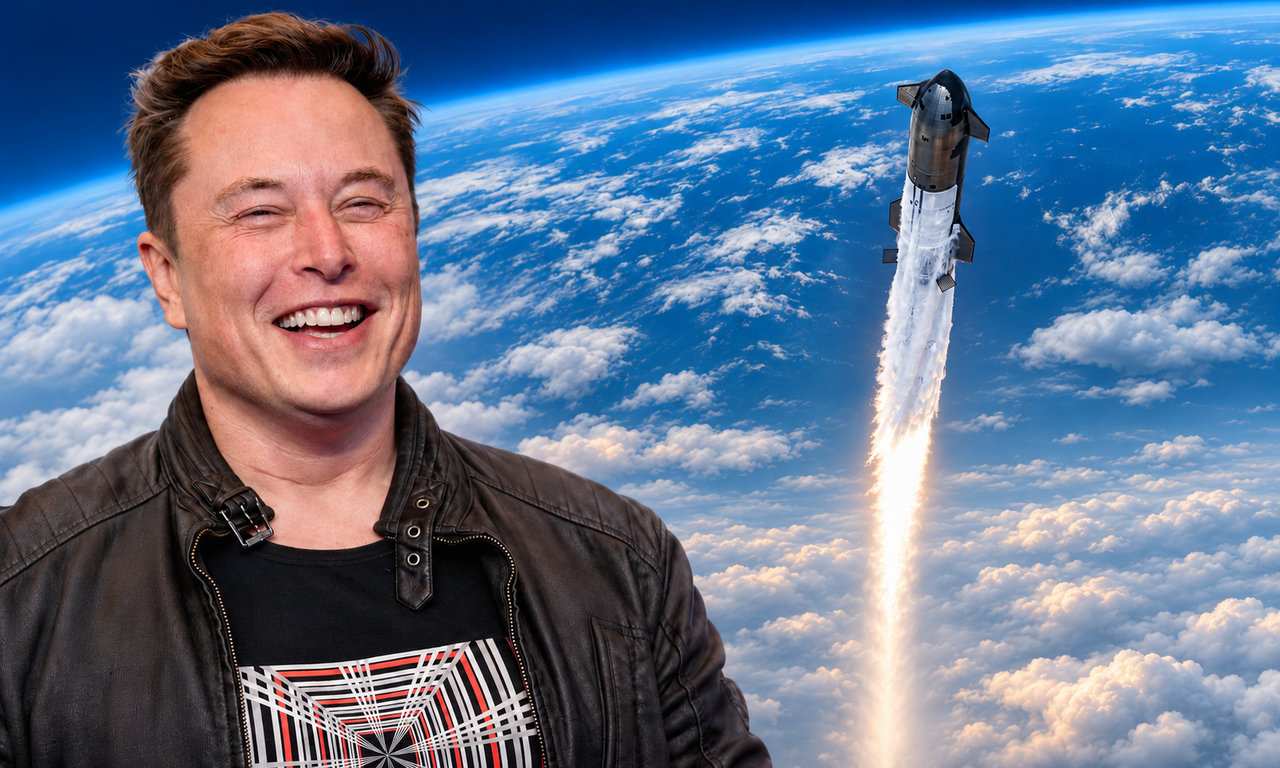
Elon Musk says the propellant for a Starship flight will cost less than $500,000 and the ship will carry more than 200 tons, and XPRIZE founder Peter Diamandis says that math puts a ride to orbit under $1,000 a person.
"Hours later, Elon tightened the fuel number," Diamandis said on Thursday's episode of his Moonshots podcast, a few days after SpaceX caught a Starship upper stage with its launch tower for the first time. "He said propellant costs per flight will drop to $500,000 and payload will increase to 200 tons."
Diamandis then did the ticket math on those two numbers himself. They mean, he said, that "a per-person ticket price could drop to below $1,000 per person to orbit."
"I find that awesome," he added.
According to Musk:
Propellant cost per flight will drop below $500k and payload will exceed 200 tons
— Elon Musk (@elonmusk) November 16, 2026
Diamandis had run his own numbers before Musk's post. On the podcast he walked through them: in a mature, reusable "refuel-and-go" transport system like a car, a ship or a plane, fuel is typically only about 25% of the operating cost. With Starship's propellant first estimated at $1 million to $2 million a launch, "that implies a total cost of $4 to $8 million per flight, or $27 to $53 per kilogram," he said.
"Just to remind you, the space shuttle was operating at about $54,000 per kilogram. This is a thousand-fold reduction in cost," Diamandis said. On those numbers, "the average 150-pound American, which is how much I roughly weigh, can go to orbit for roughly $2,000 to $4,000. It's the same as a first-class airline ticket."
On Diamandis' own rule of thumb, Musk's figures cut that again: $500,000 of propellant points to about $2 million a flight, or about $10 a kilogram across 200 tons, which for a 150-pound passenger comes to roughly $700.
The new numbers came days after Flight 15, which Diamandis called "the big story of this week." Ship 42 lifted off from Starbase on Friday evening, deployed 26 Starlink V3 satellites and coasted for about 22 and a half hours. On Saturday it came back down into the tower's arms, the first catch of a Starship upper stage. The Super Heavy booster was diverted to the Gulf instead of the tower.
Views from Mechazilla of the first ever Starship catch pic.twitter.com/mcoWaqnkaU
— SpaceX (@SpaceX) November 16, 2026
"Fully reusable spacecraft have been the golden, you know, the target," said Diamandis, who puts his own time in the space business at 40 years. "It changes everything."
On Sunday Musk also laid out the next version of the ship. Starship V4 will be about 70 meters long, roughly 40% longer, with more than 60% more propellant, and nine engines, three of them added Raptor-Vacuum engines:
Starship V4 will be ~70m long, which is roughly a 40% length increase and allows >60% more propellant load.
Engine count will be raised to 9, with 3 more Raptor-Vacuum engines added, and these will be higher thrust V4 engines. https://t.co/VxrFs7FImC— Elon Musk (@elonmusk) November 16, 2026
Musk first put propellant at about $500,000 a flight more than six years ago. In May 2020 he wrote that Starship and Super Heavy together carry 4,800 tons of propellant and that he thought SpaceX could get propellant down to about $100 a ton at volume, "so ~$500k/flight," and probably "below $1.5M fully burdened cost for 150 tons to orbit or ~$10/kg." What has changed since is the hardware: both stages have now been caught by the tower, and Musk's payload number has gone from 150 tons to more than 200.
Starship + Super Heavy propellant mass is 4800 tons (78% O2 & 22% CH4). I think we can get propellant cost down to ~$100/ton in volume, so ~$500k/flight. With high flight rate, probably below $1.5M fully burdened cost for 150 tons to orbit or ~$10/kg.
— Elon Musk (@elonmusk) May 8, 2020
Alexander Wissner-Gross, one of the Moonshots regulars, said his first reaction was that "the solar system is cooked," and likened the moment to the shift from circuit switching to packet switching: space missions built from "hundreds or thousands of individual packetized flights" instead of one named launch at a time.
Fellow panelist Dave Blundin put the fuel bill in grocery terms: "If you say, hey, this weighs about a pound. I want to put this in orbit. How much fuel do I need to get this thing into orbit? It's a dollar a pound."
Needless to say...