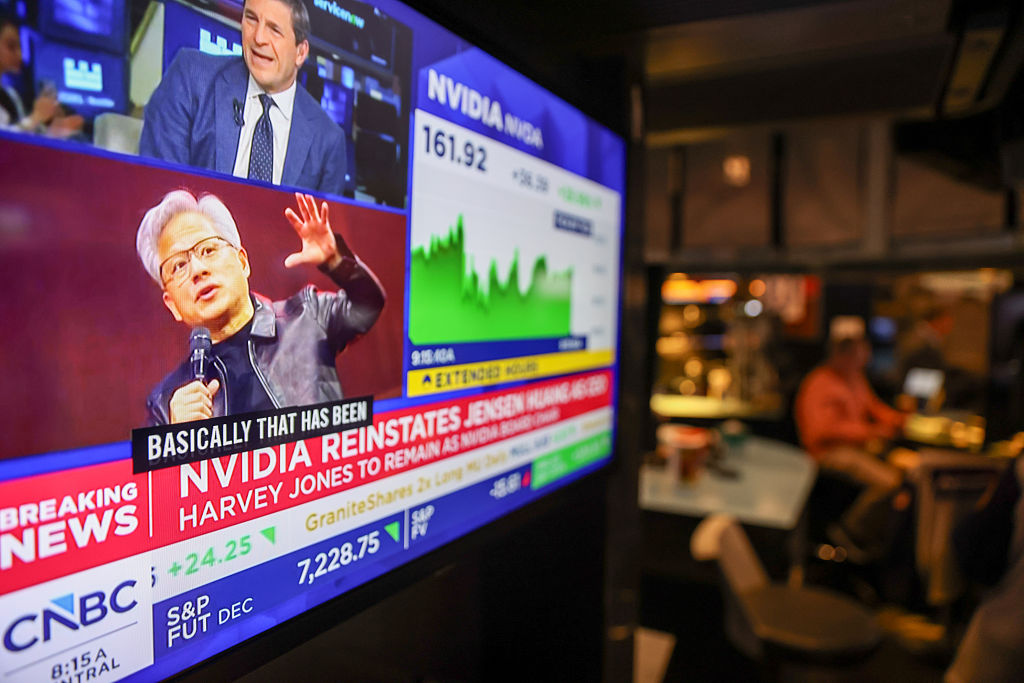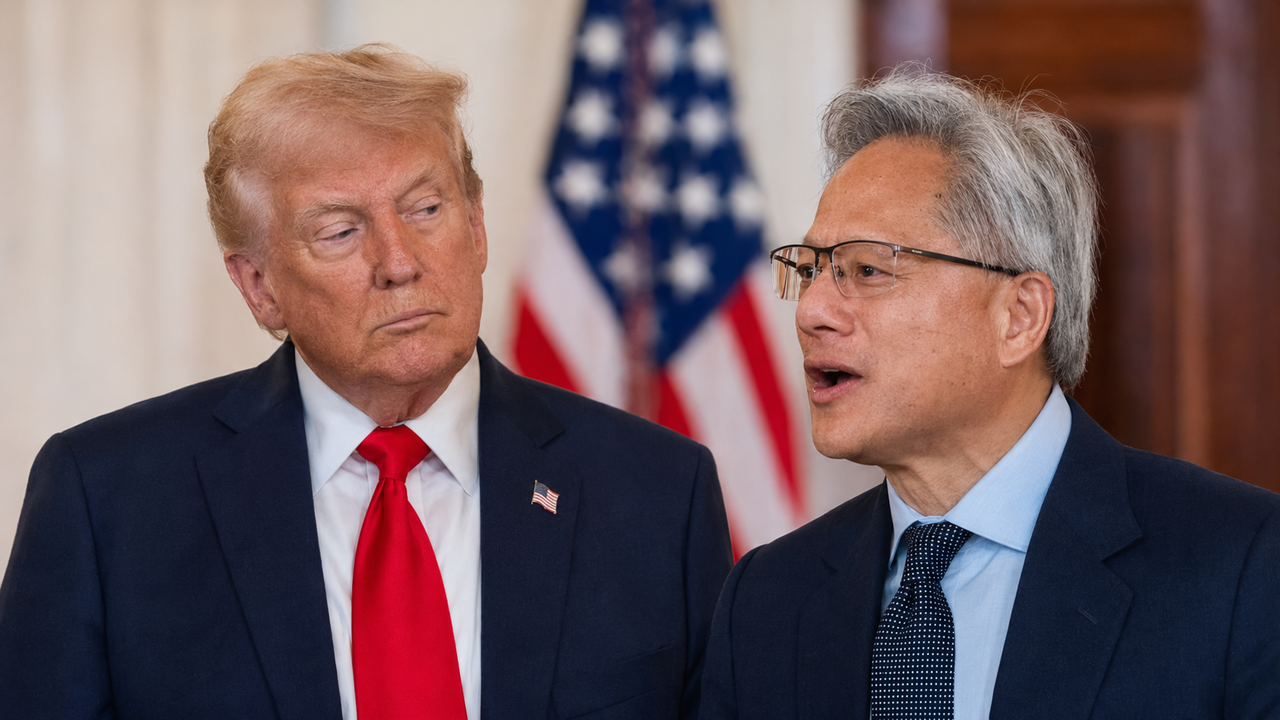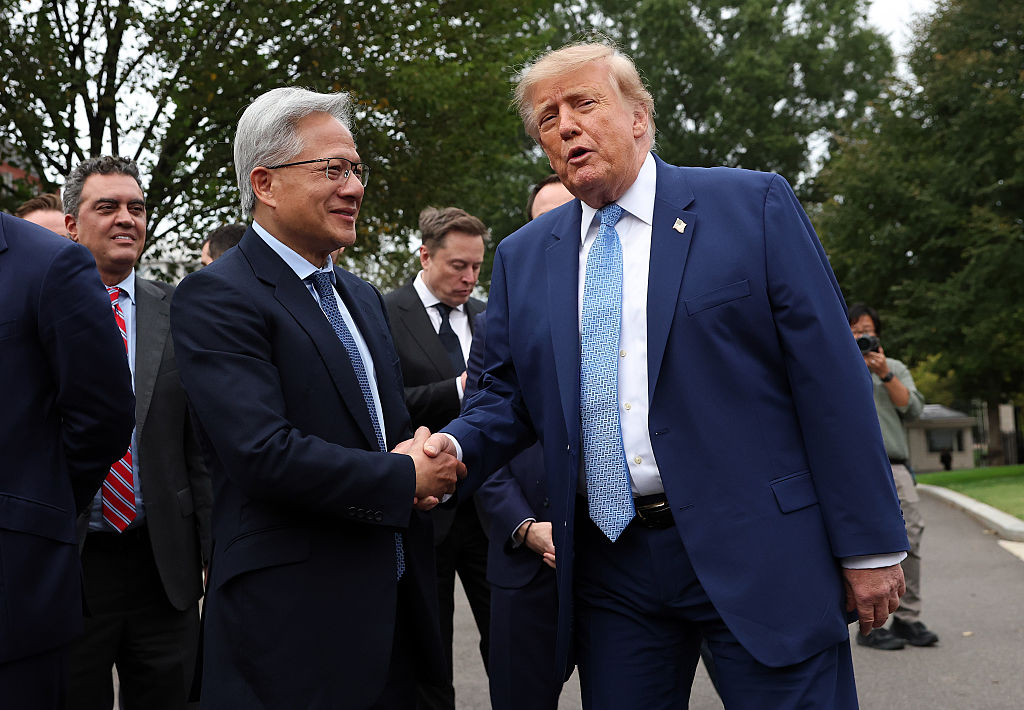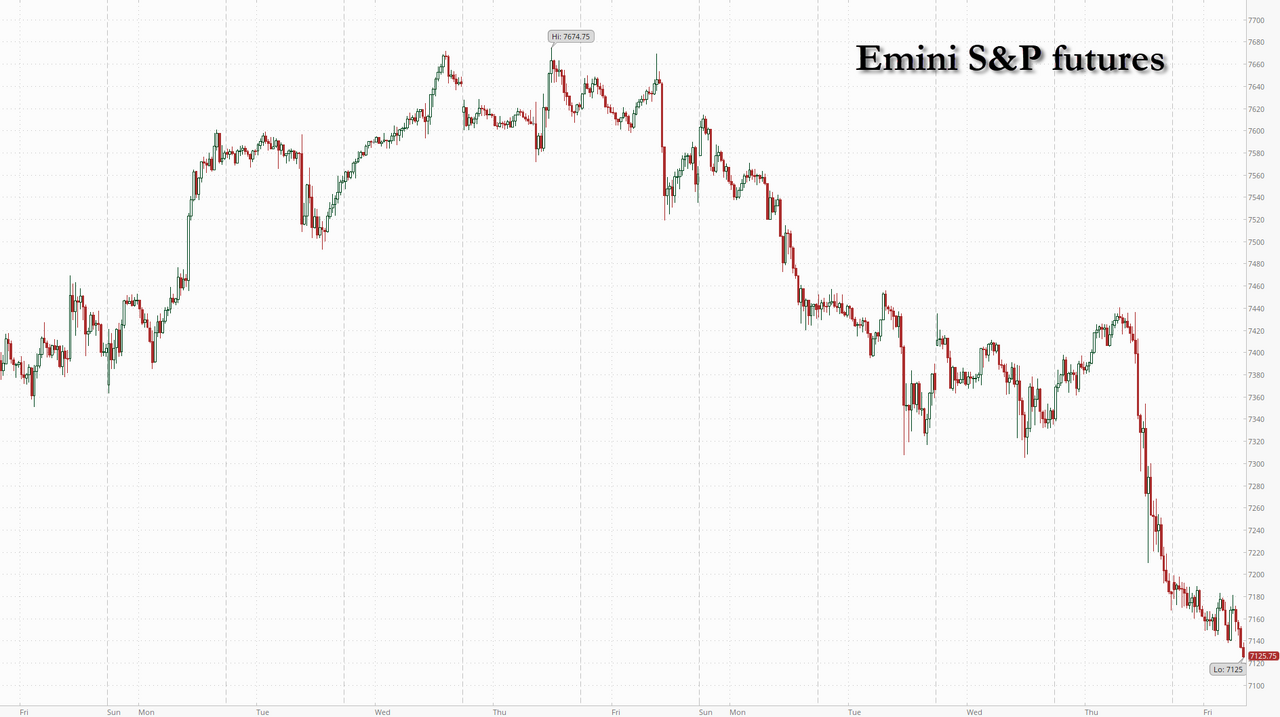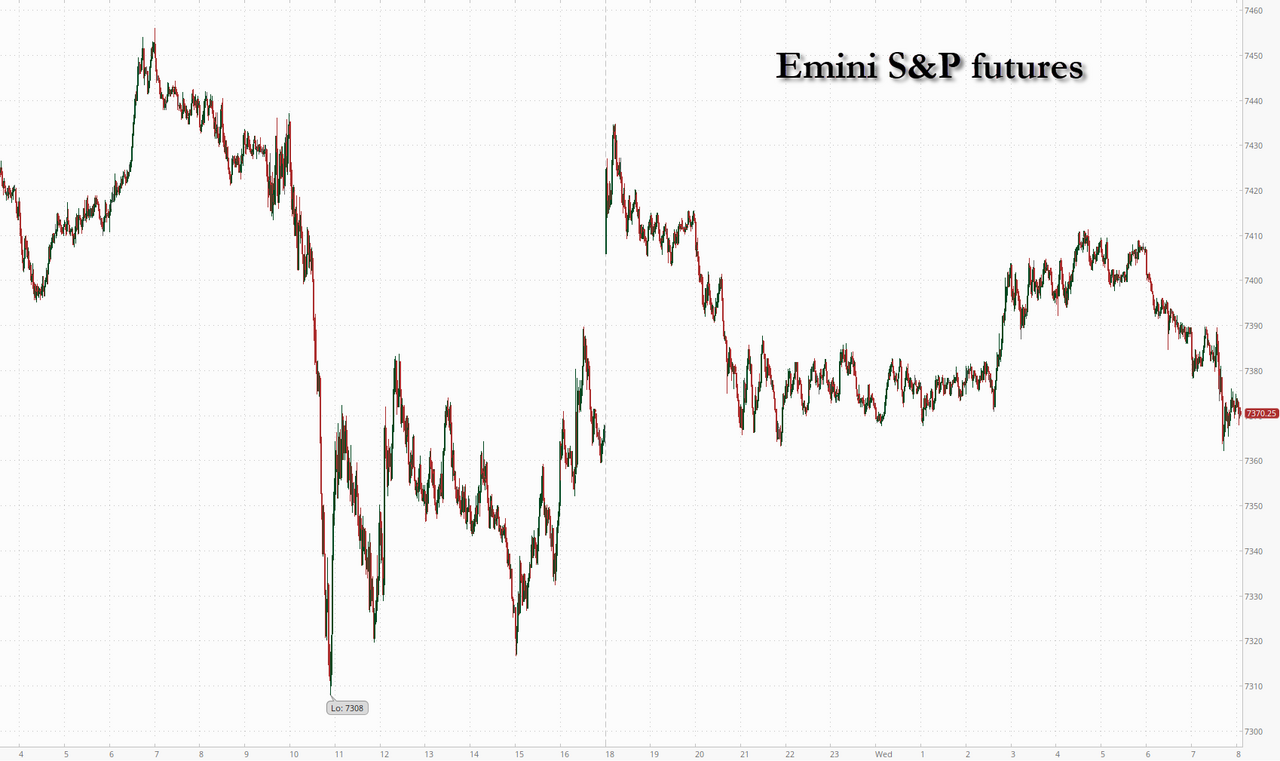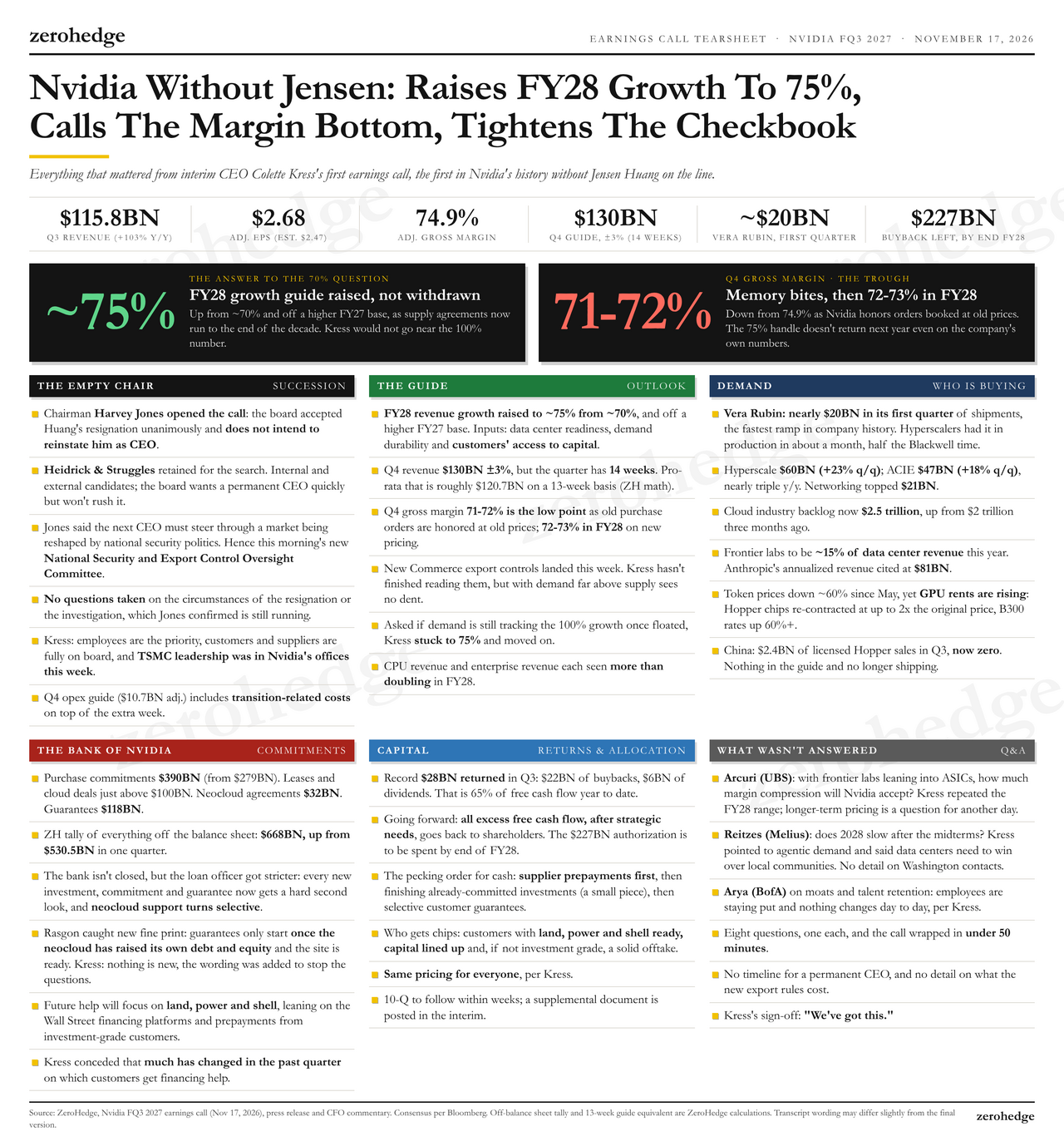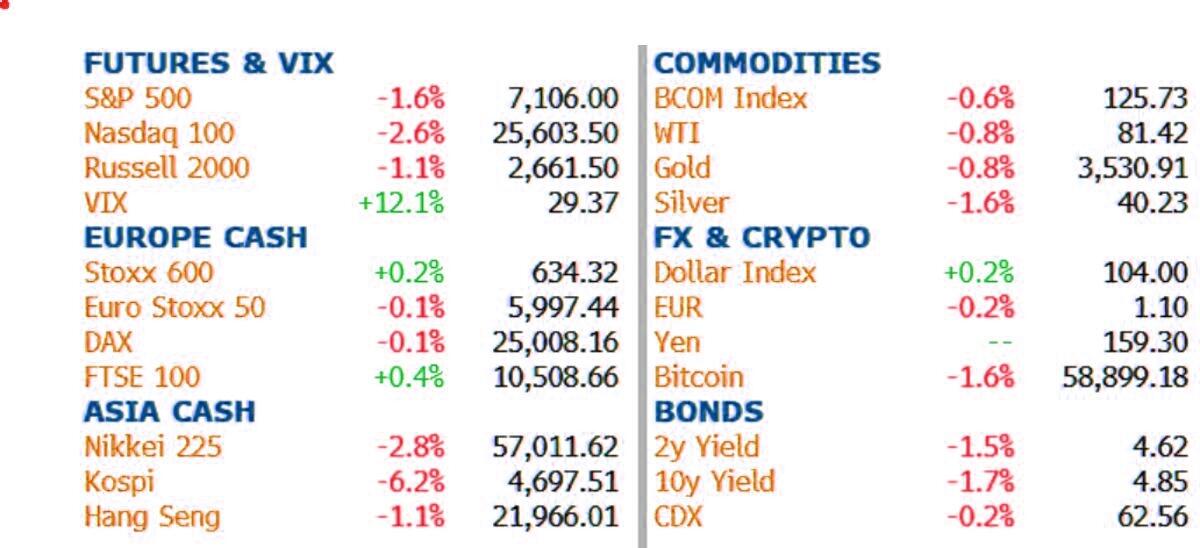
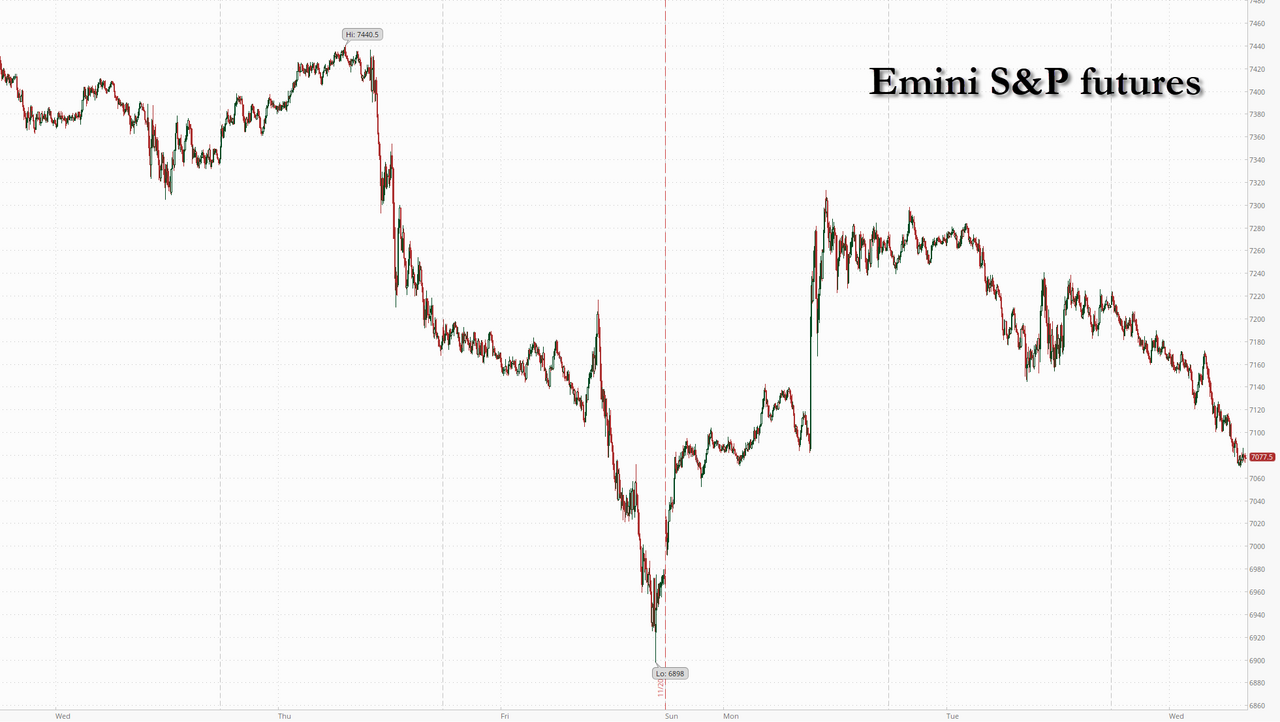
US futures tumble as the AI rout resumes with a vengeance: Monday's Jensen Huang euphoria has now fully evaporated and replaced by a Huangover, after Trump told the NY Post a pardon for the Nvidia CEO was "always an option" and mused about the government taking a stake in Nvidia, Asian chipmakers crashed overnight with the Kospi plunging 6.2%, and the haven bid that followed has sent Treasuries sharply higher; as a result the 10Y yield slid as much as 9bps to 4.84%. As of 8:10am ET, S&P futures are at session lows, 1.9% lower and sliding below 7,100, while Nasdaq futures are down 2.9% at 25,603.50, below the levels seen before Monday's announcement of Huang's return, and Dow futures are 1.3% lower. The slide follows Tuesday's session in which the S&P fell 0.5% and the Nasdaq 100 2%, but the equal-weight S&P rose 0.5% as the SOX gave back 7.9% (more than half of Monday's 14% moonshot, as we noted yesterday). In premarket trading, Mag 7 names are all lower led by Nvidia (-5%), while Dell slides 7.5% even after raising its outlook as fear of an AI earnings peak overshadows the beat, Workday drops 9% on a "modest" guidance boost and Ambarella craters 35%. The day's driver is Nvidia (again): Trump said he is willing to pardon Huang if needed ahead of the CEO's testimony before Congress next week, prompting JonesTrading's Mike O'Rourke to question whether Huang's return came too soon, while Goldman's desk estimates CTAs will dump $68 billion of global equities over the next five days. Treasuries are 6-8bps richer across the curve on the flight to safety, with the 2Y at 4.62%, while European bonds also rally, with gilts outperforming as Dutch gas prices drop 4% on milder weather forecasts. The Bloomberg Dollar Spot index is up 0.2-0.3% and the DXY is back at 104.00 as haven demand dominates FX; the Swiss franc leads G10 while the Aussie plunges 1.2% to 0.6559 despite a hot October CPI print. Oil swings between gains and losses (WTI -0.6% at $81.57) as Houthi attacks on Saudi Arabia's Ras Tanura refinery and Iranian claims of two tankers hitting mines in Hormuz offset rising supply; gold is down 0.8% at $3,531 but still holding $3,500, silver drops 1.6% and the metals rout deepens, while bitcoin slides 1.6% to below $59,000. US economic data slate is jam-packed ahead of Thanksgiving: MBA mortgage applications (7am), October personal income/spending and PCE, the second estimate of Q3 GDP, initial jobless claims and October durable goods (all 8:30am), and October new home sales (10am); the Fed releases its Beige Book at 2pm. Fed speaker slate includes Bowman (7:25am). The Treasury sells $44 billion in 7-year notes at 11:30am.
In premarket trading, Mag 7 stocks are all lower led by Nvidia: (Nvidia (NVDA) -5%, Amazon (AMZN) -3%, Alphabet (GOOGL) -3%, Tesla (TSLA) -2.5%, Microsoft (MSFT) -3%, Meta Platforms (META) -2%, Apple (AAPL) -0.9%)
- Chipmakers, cloud computing providers and other AI infrastructure players are lower as the AI trade continues to falter.
- Ambarella (AMBA) drops 33% after fourth quarter sales guidance from the semiconductor firm came in roughly 35% below consensus expectations.
- Autodesk (ADSK) falls 5% after the 3D design software company posted third quarter results and provided a forecast. BI analyst Niraj Patel writes that the company’s sales growth appears set to slow after fiscal 2027.
- Deere (DE) is down 2% as the company isn’t as upbeat as most analysts on 2027, a year that was widely expected to mark the turning point in a slumping farm economy.
- Dell (DELL) falls 4%, tracking a decline seen across stocks exposed to the AI trade. Strong third quarter results and a guidance uplift failed to quell investors’ concerns that the server maker’s earnings are nearing a peak, analysts said.
- GoodRx (GDRX) sinks 6% after the drug-pricing comparison software company said it expects revenues for its Pharma Direct unit to decline in 2027 due to worsening unit economics. The company also said it sees total revenue growth in 2027 as “unlikely.”
- Nutanix (NTNX) drops 10% after the cloud computing company said CEO Rajiv Ramaswami will step down after a successor is hired.
- Urban Outfitters (URBN) is down 12% after the apparel company guided to flat comparable sales at its biggest brand Anthropologie, disappointing analysts who had expected a quicker recovery. Morgan Stanley downgraded its rating, while JPMorgan cut its price target on the stock.
- Workday (WDAY) falls 4% after the software company’s full-year subscription revenue guidance boost failed to impress, with CFRA calling the raise “modest.”
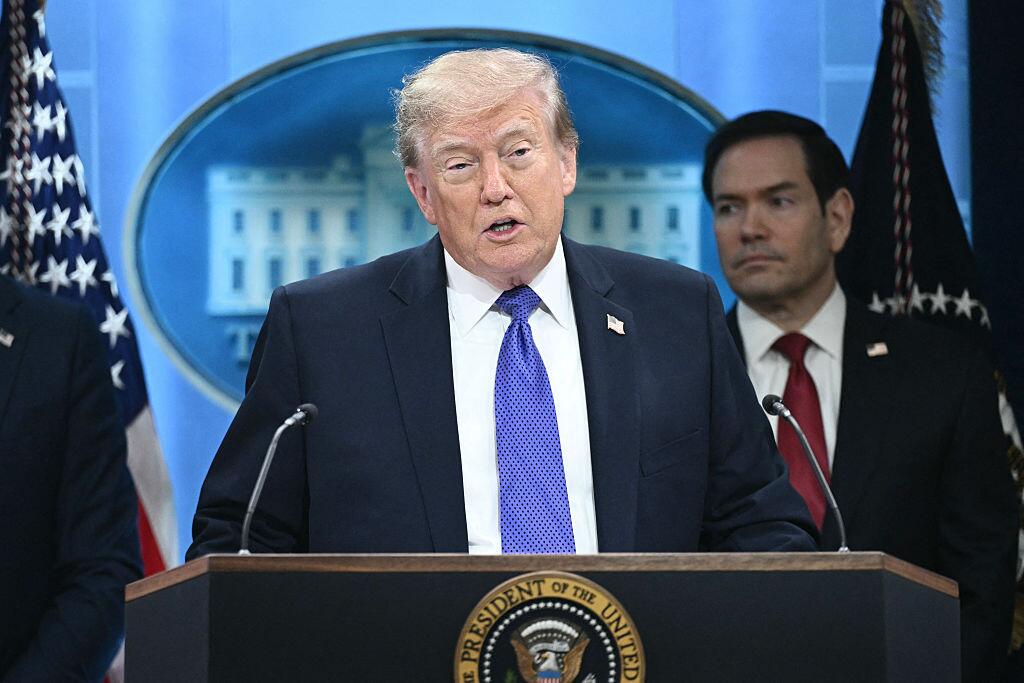
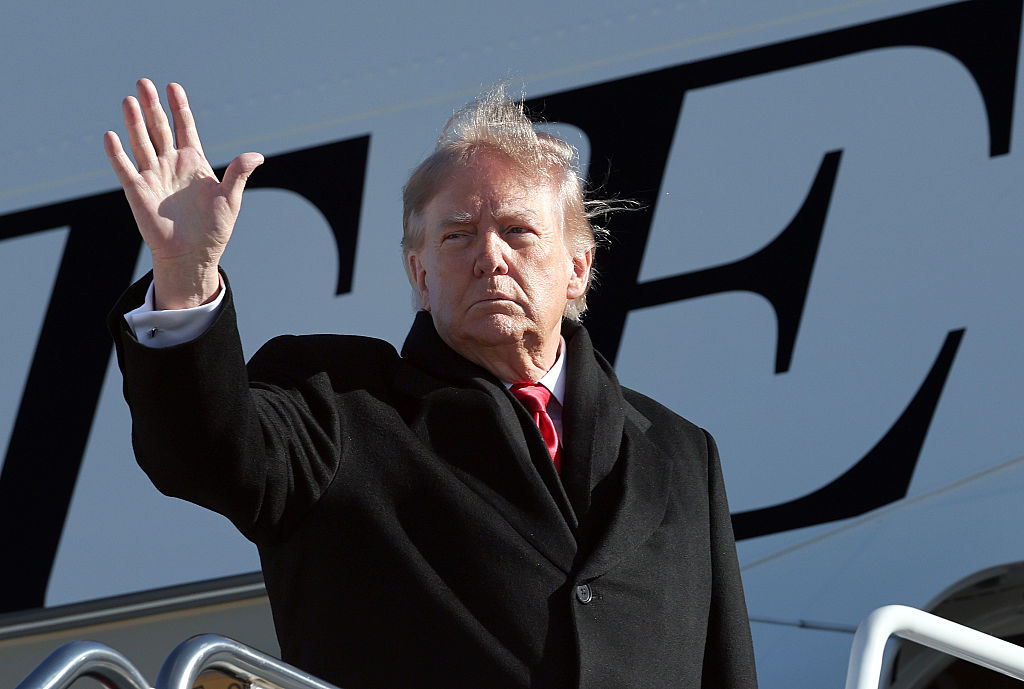
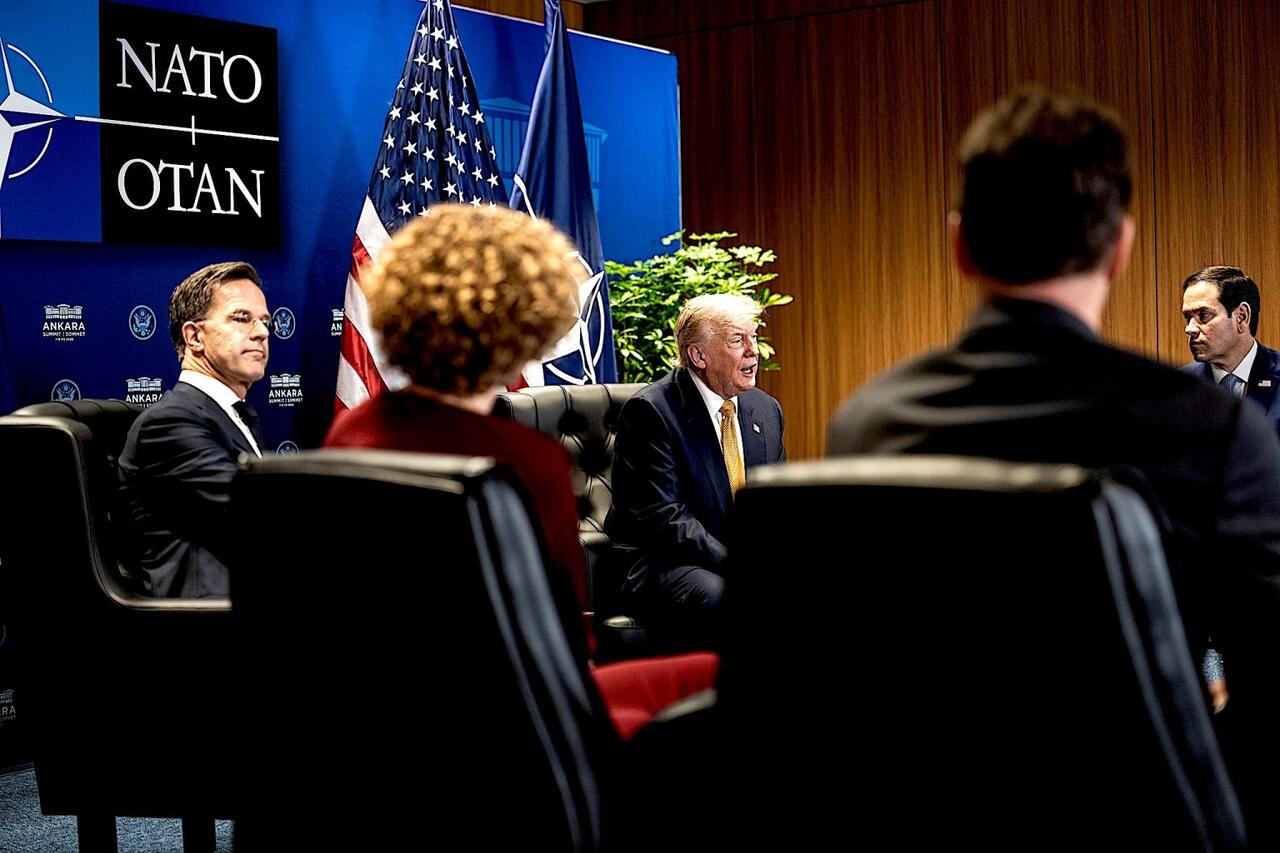
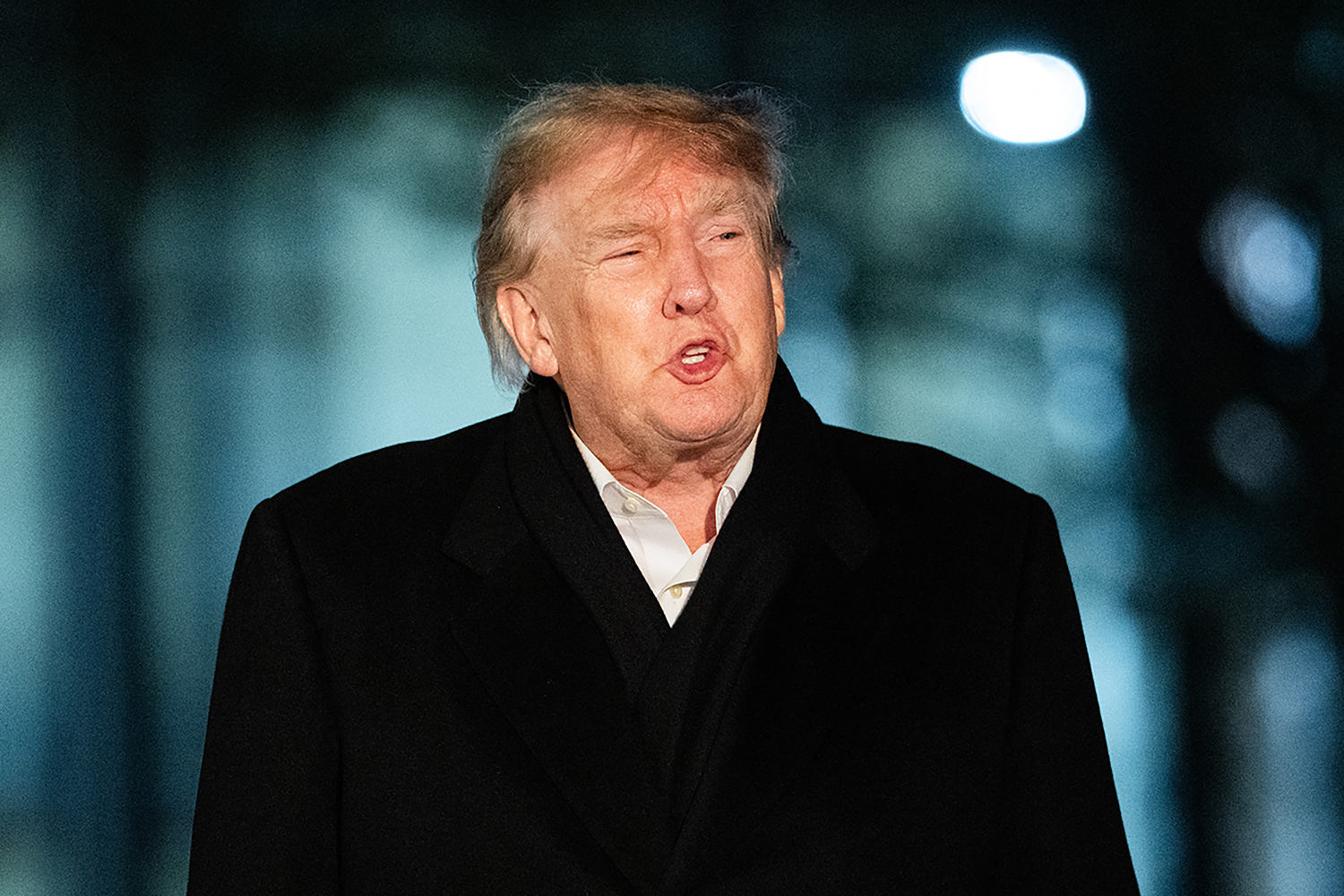
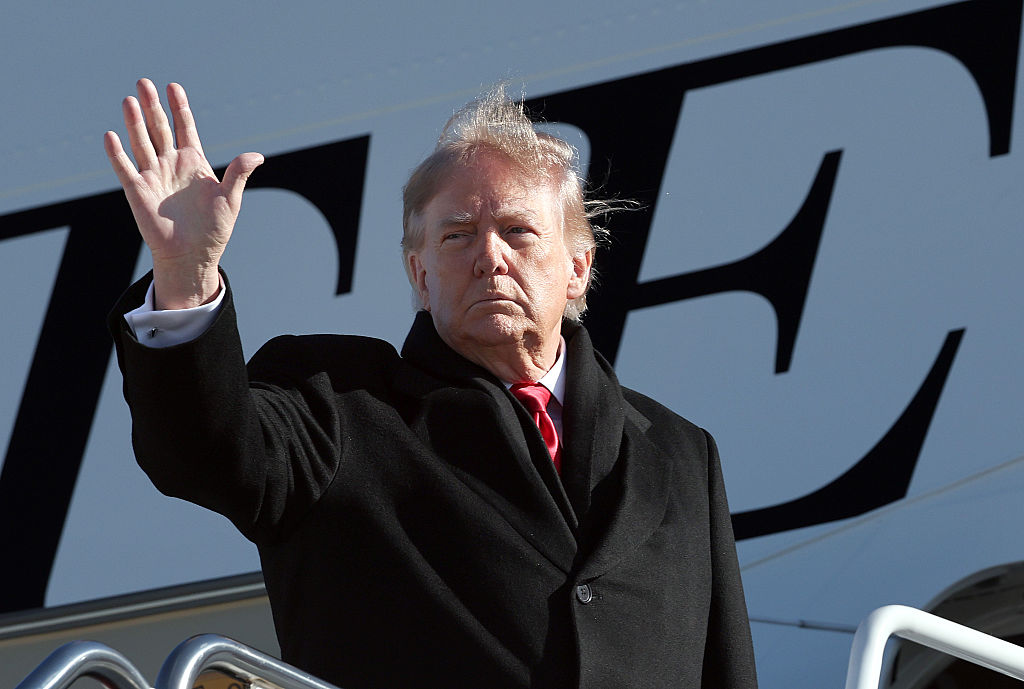
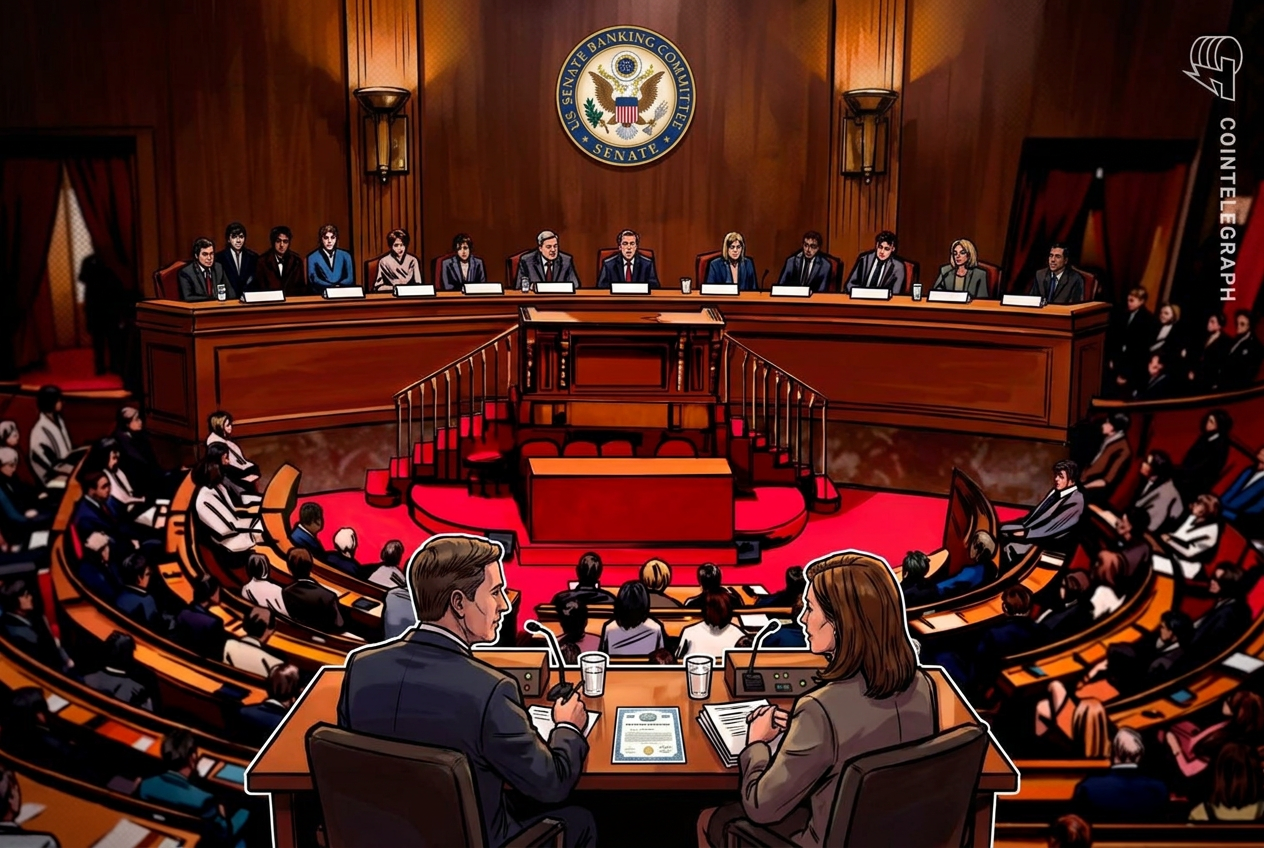
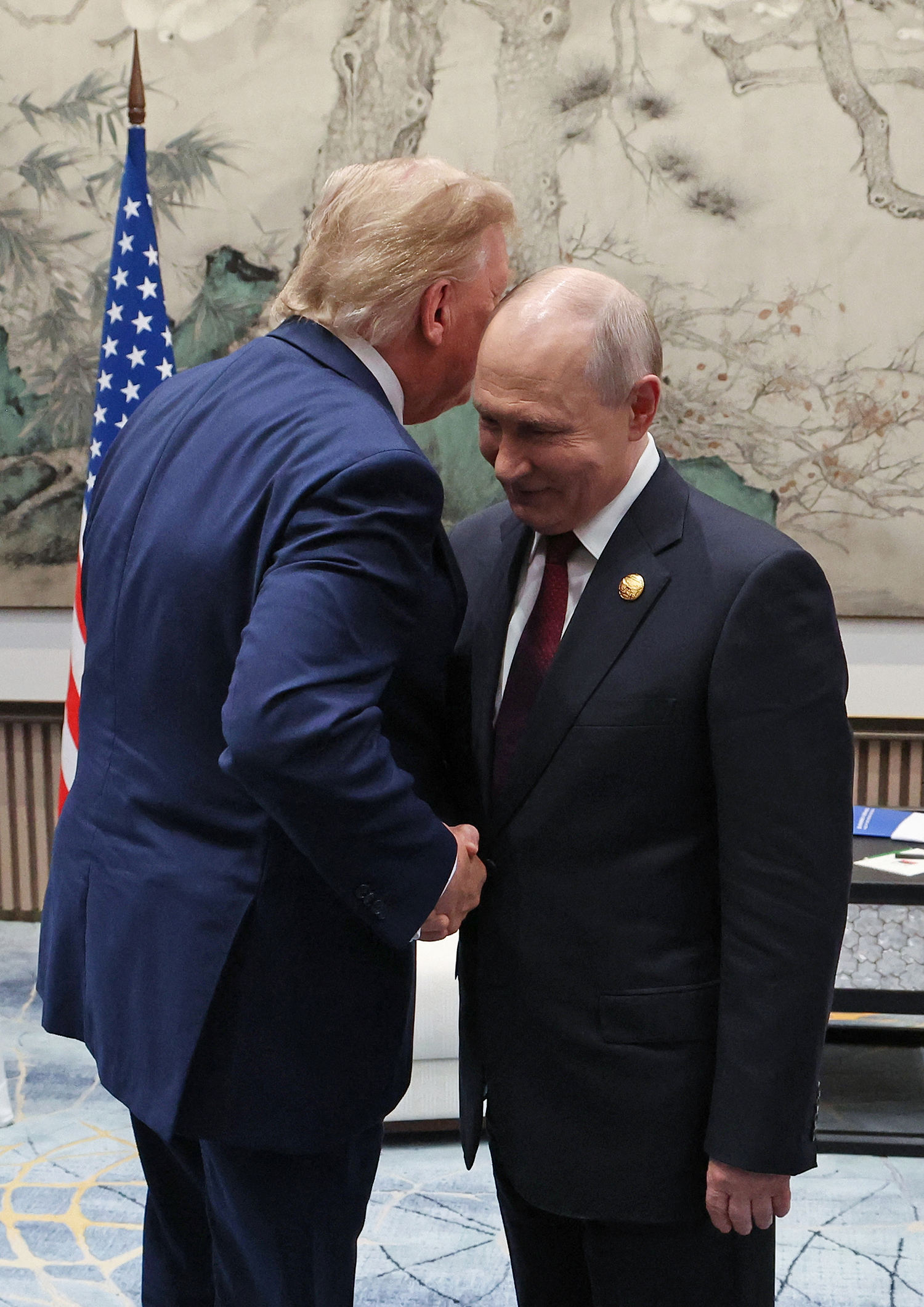
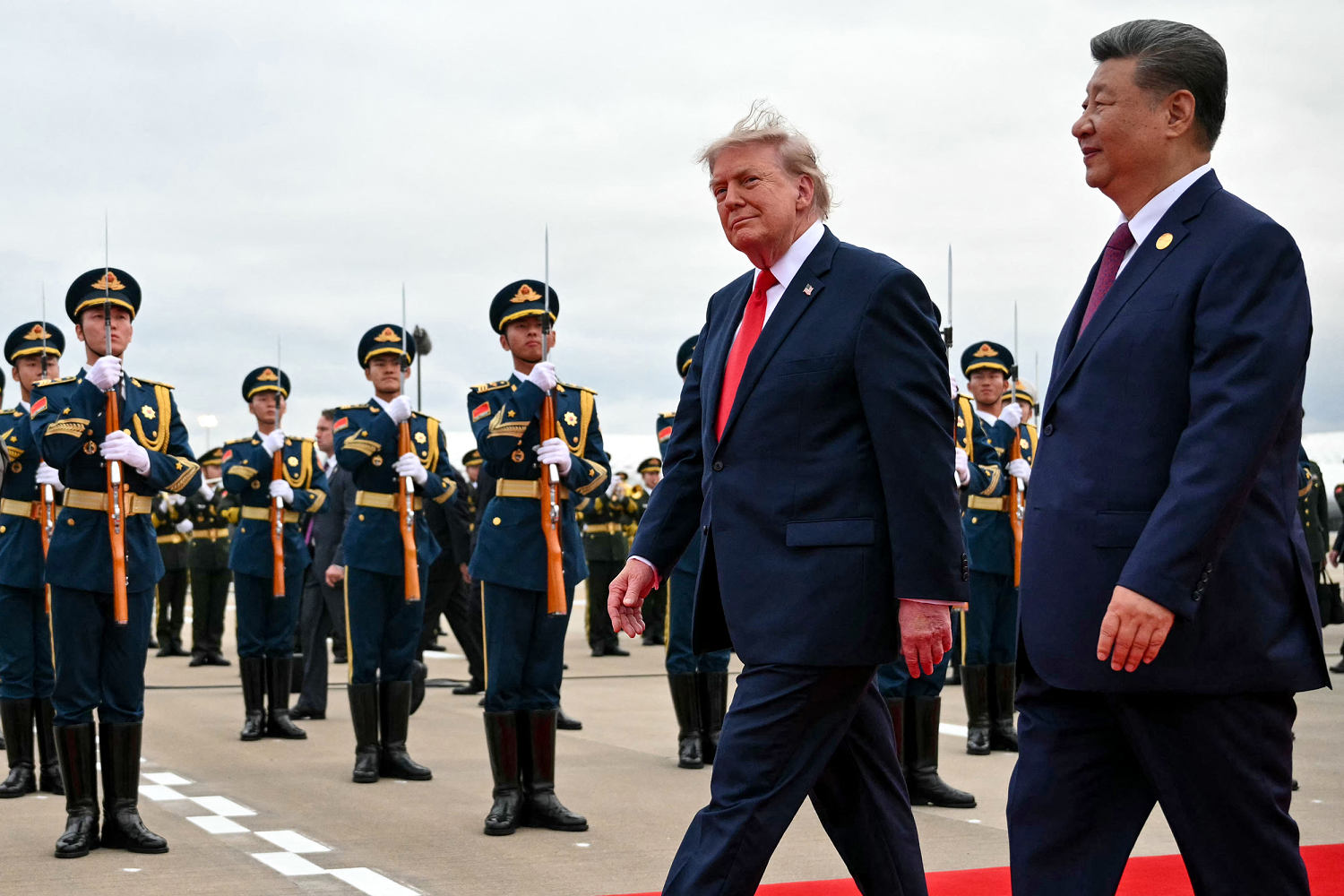
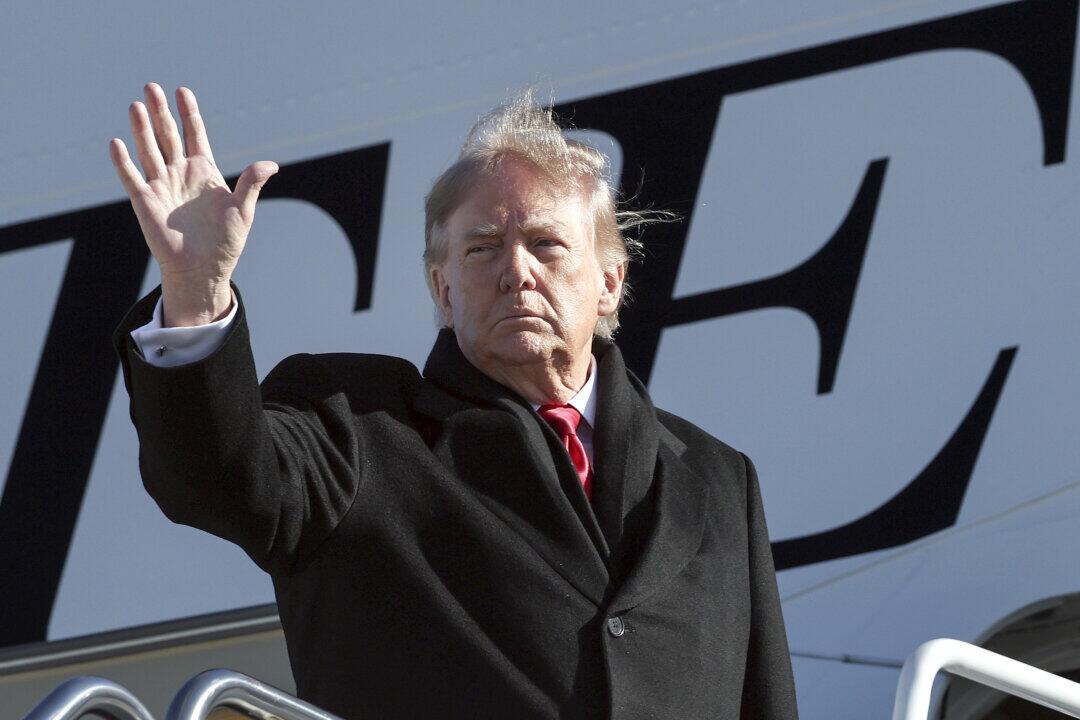
In other corporate news, Trump added another chapter to the Nvidia soap opera, telling the NY Post a Huang pardon was "always an option" and that he has thought about the US government taking a stake in Nvidia, while also saying Huang is probably fine without one and should tell Congress the truth; Huang is due to testify before the Senate Banking Committee on Dec. 3. Banks from Citigroup to Standard Chartered have launched sweeping reviews of data center clients after tougher US rules to curb Chinese use of advanced chips in Southeast Asia. A consortium including BlackRock and IFM is considering lowering its offer for Stack Infrastructure's Asia Pacific data centers (because nothing says confidence in the AI buildout like a price cut). Dell raised its full-year revenue outlook for the third time and reported a record $132.3 billion AI backlog, but margin compression was evident. Deere's Q4 net income of $1.05 billion missed estimates of $1.08 billion and its 2027 profit forecast fell short of consensus. Starbucks has tapped advisers for a potential multibillion-dollar sale of its Japan business; Kymera Therapeutics upsized its share sale to $1.75 billion, the largest US biotech offering this year; TSMC is weighing a $21.7 billion advanced chip plant in Texas; and RBC says a Tesla-SpaceX merger announcement could come in early 2027, confirming our report.
The global tape has flipped right back into "sell AI" mode: Asian tech crashed, with a Bloomberg gauge of regional semiconductor stocks plunging more than 9%, Nasdaq futures are below their pre-Huang levels, and the AI slide is now spilling into bonds and currencies, with Treasuries, JGBs and the dollar all catching a bid. Meanwhile, Europe's defensive-heavy indices are once again the beneficiary of the rotation. It's a remarkable reversal from Monday, when Nvidia soared 31% on Huang's return; as we said in last night's close, it's yet another Huangover, and Goldman's Rich Privorotsky had already called Monday's rip "bear market" price action. Adding to the gloom, the US is preparing to raise tariffs on China, the EU and more than a dozen other economies to replace levies struck down by the Supreme Court, as we reported yesterday, and China called the prospect "political maneuvering".
“If you want to de-risk your portfolios, Treasuries are quite a natural place for investors to park cash,” said Mark Preskett at Morningstar Wealth. “Yields are pretty attractive at these levels, even in this inflation environment.”
JonesTrading's Mike O'Rourke argues that Trump's pardon comments mean shareholders, management and Nvidia's board should be asking whether Huang was reinstated too soon. Bloomberg's Before the Bell team adds that with a December Fed hike still a live issue and thin holiday liquidity amplifying positioning flows, investors may be reluctant to rebuild exposure in the short term regardless of today's PCE print.
"The combination of still-elevated underlying inflation and resilient real consumption is likely to push the Fed to hike in December," wrote economists Andrew Sacher and Troy Durie (Bloomberg Economics).
Barclays strategist Emmanuel Cau notes that market volatility has pushed investor exposure to global equities to its lowest this year, but positioning is not yet at the broad capitulation levels that historically marked major buying opportunities. Deutsche Bank strategists say volatility shocks can take six to eight weeks to play out before equities bottom, though they remain bullish on next year with an end-2027 S&P target of 9,000.
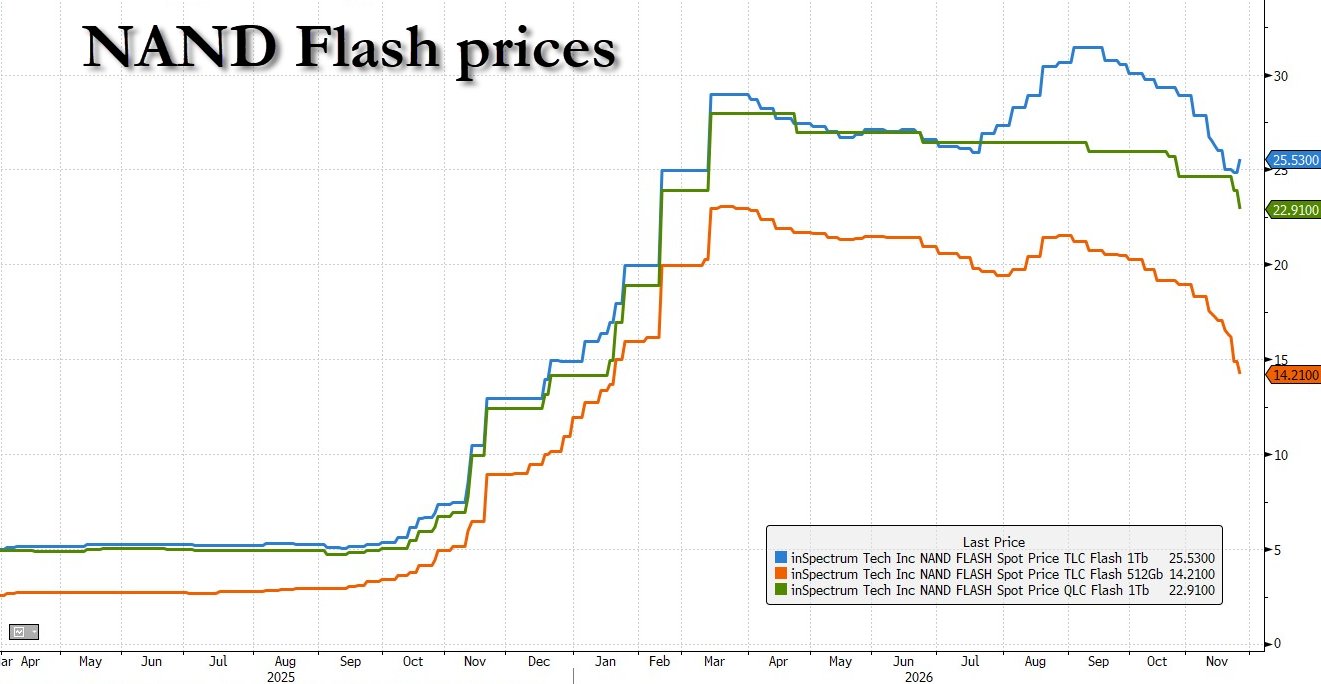
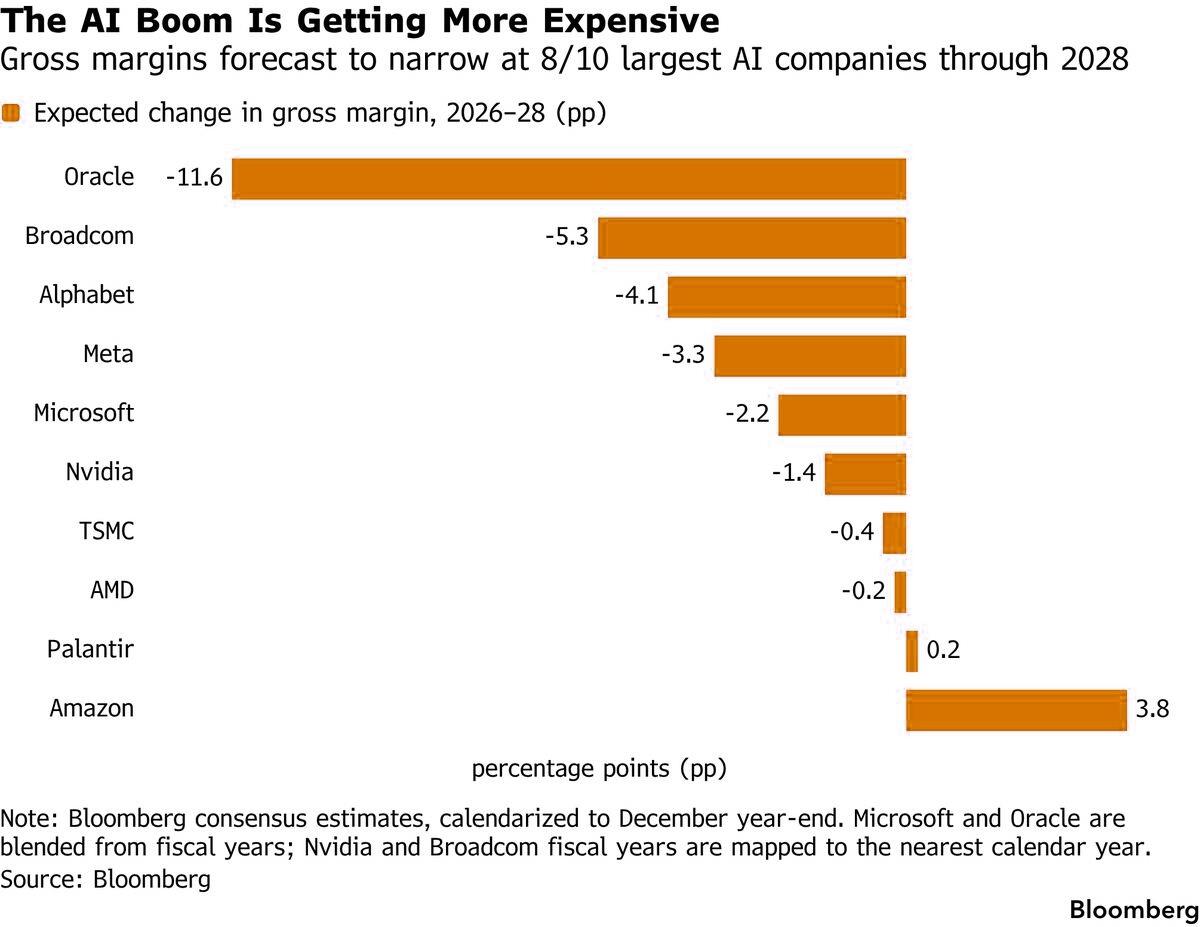
The fundamentals are starting to wobble too: consensus 2027 gross margin estimates have fallen for eight of the ten largest AI names, NAND spot memory prices are down 25% in November alone, and Analog Devices and Semtech both plunged 17% on Tuesday after disappointing results.
“AI is a very mature bull cycle,” said Mark Preskett at Morningstar Wealth. He added that current valuations and a potential peak in profit margins “suggest perhaps it's not the best time to allocate a lot of capital.”
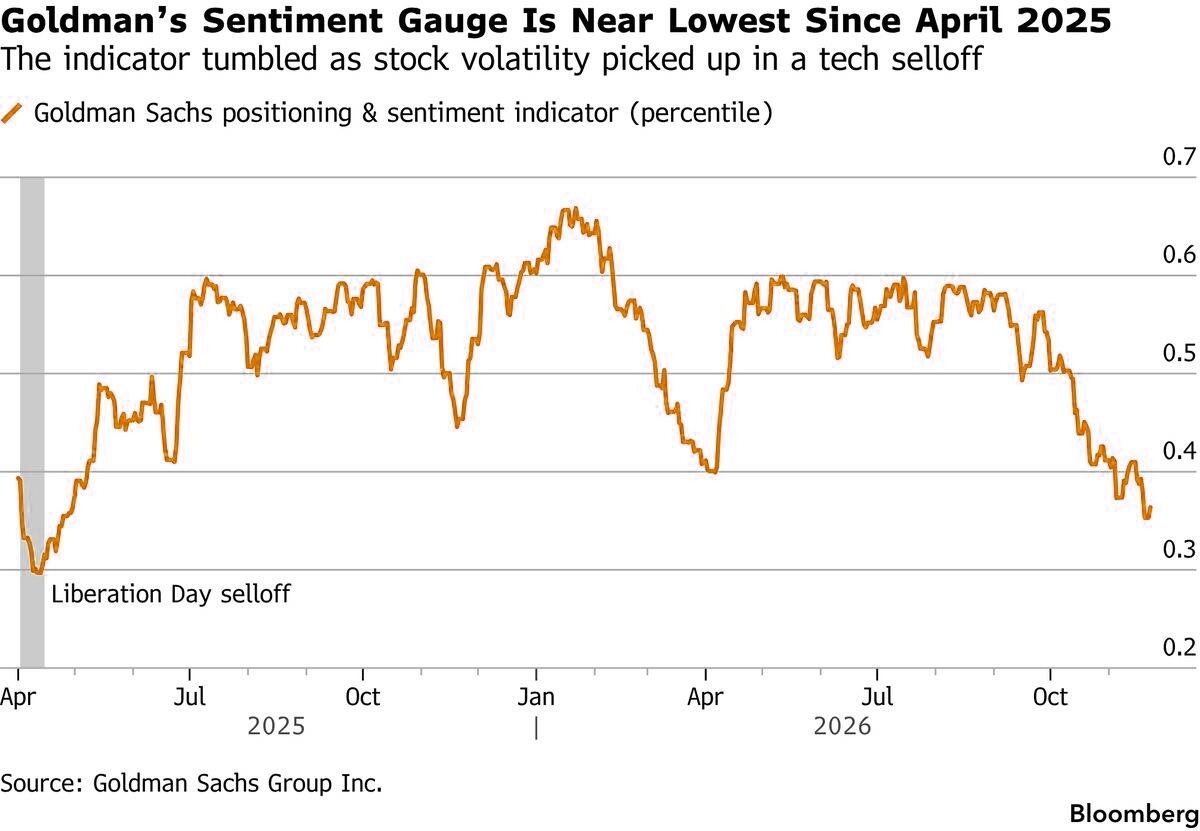
The fractious mood has left a Goldman equity sentiment and positioning indicator near the lowest since the April 2025 tariff turmoil.
“We had extremely concentrated positioning in tech,” said Carlota Estraques Lopez at St. James's Place. “Once that starts to unravel, it can expose a lot of this vulnerability.”
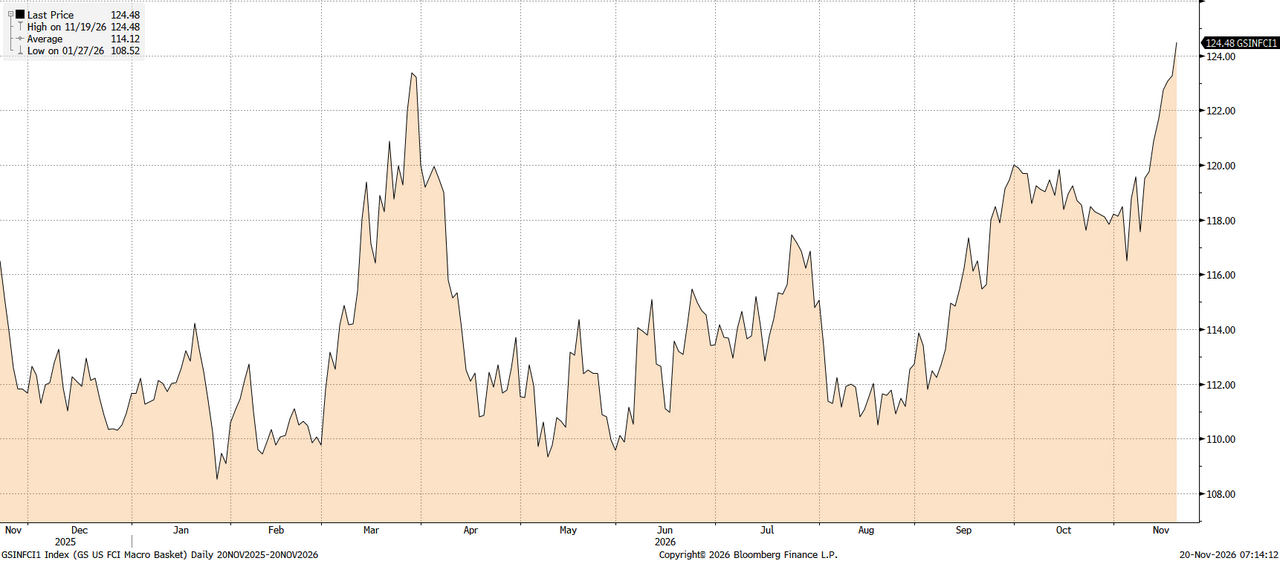
On Goldman's desks, there was no fresh overnight note from Rich Privorotsky, but his London colleagues picked up where he left off. Anton Tran (EMEA sales) writes that the Jensen bounce was "short lived, but massively aggressive" for a $3 trillion company, and the gains are already fading; he wonders whether Huang is now "too big to fail/fire", whether government involvement is a worry, and what it will take for the market to regain confidence in AI. His conclusion: we are back in a macro over micro regime, with a 25bp December hike fully priced and a softer PCE perhaps the only thing that could reignite some NVDA sentiment. Tran also flags that Goldman's Financial Conditions Index has tightened about 100bp this year, almost half of it last week, while on the day of the Huang comeback levered ETFs hit a record 25% of ETF volume, and the T+1 bounce in Asia was mostly short covering, with the Taiex up 9% on its lowest volume of the year.
“Central bank tightening doesn't rule out medium term gains in risk assets. Hikes partly reflect strong growth, and markets may only need reassurance that more aggressive tightening is off the table. But today's inflation data is unlikely to provide it, while continued whipsaws are hurting sentiment and triggering mechanical derisking,” said Bloomberg macro strategist Skylar Montgomery Koning.
Goldman TMT specialist Sean Johnstone says Huang's return "is not a clearing event for semis", with TMT investors thin on P&L and selling the bounce to sit out the year; CoreWeave bonds hit record lows after HPE Financial Services said it avoids neocloud financing (see our take on what the swap market says about AI credit). In the US, Sam Dunn notes that momentum exposure has swung from a record +70% in June to negative, the lowest since late 2022, even as equity ETFs have taken in more than $200 billion since the October Nasdaq peak; long-only sellers were back in NVDA with "limited/no defence", and the question on the floor is whether semis and AI infrastructure need estimate cuts before they can bottom.
JPMorgan's Market Intelligence desk under Andrew Tyler has moved back to Tactically Cautious, arguing that 2018 is the best historical comp, when a late-year tactical bounce was faded; the desk expects a further rotation away from tech and would need a positioning reset, cyclicals outperforming defensives and lower vol to turn bullish again. JPM's international team adds that pre-Huang Nasdaq futures levels may signal a floor, and that broadening is the name of the game, with healthcare and staples leading; meanwhile JPM's positioning team says hedge fund net selling and the drop in net leverage are approaching extreme levels, though a broader capitulation has yet to be confirmed. US Market Intel is not publishing again until Nov. 30, so enjoy the turkey.
In Europe, the Stoxx 600 is up 0.3% at 634.77, bucking the global selloff as investors hide in its defensive-heavy mix, with 362 members up and 225 down. Autos lead after JPMorgan outlined its sector favorites for 2027, while tech and banks lag; France's CAC 40 outperforms, up about 1%, after the National Assembly approved the 2026 year-end budget bill, which confirms a 5.4% of GDP deficit. Here are the biggest European movers:
- Elekta gains as much as 13%, to the highest since October 2024, after the Swedish medical products maker reported operating profit for the second quarter that beat the average analyst estimate.
- Bureau Veritas shares rise as much as 12% to a record high on the news Advent is considering a bid to acquire the French testing firm.
- Pets at Home shares rise as much as 12%, hitting the highest level in two years, after the UK retailer reported what analysts described as strong 1H results and upgraded its outlook for the year.
- BioArctic shares jump as much as 9.9% to trade at a three-month high after the Swedish biotech’s third-quarter operating income and Ebitda beat the average analyst estimate, while the roll-out of Alzheimer’s therapy Leqembi is seen as a catalyst for sales growth.
- Swatch shares rise as much as 6.5%, the most since May, after UBS upgraded the stock to neutral from sell, citing strong global momentum in watches, particularly in the US.
- Aroundtown shares rise as much as 5.6% after the real estate firm raised its earnings and dividend guidance for the full year.
- Sanofi shares climb as much as 5%, to the highest since May 2025, adding to yesterday’s strong gains following the announcement of its planned acquisition of US drugmaker Insmed.
- European autos rise on Wednesday as JPMorgan makes several rating changes within its European automotive coverage, while outlining that trucks, technology and luxury cars, and tires are its preferred sub-sectors for 2027.
- Royal Unibrew shares slip as much as 2.6% after Deutsche Bank downgrades the stock to sell from hold.
- OMV shares decline as much as 2.9% after UBS downgrades the Austrian oil and gas company to neutral from buy, citing challenges outside its control and a slightly higher valuation compared to peers.
- Prosus shares fall as much as 4% after the tech investor reported first-half Ebitda that missed consensus estimates and provided more conservative guidance for fiscal 2027.
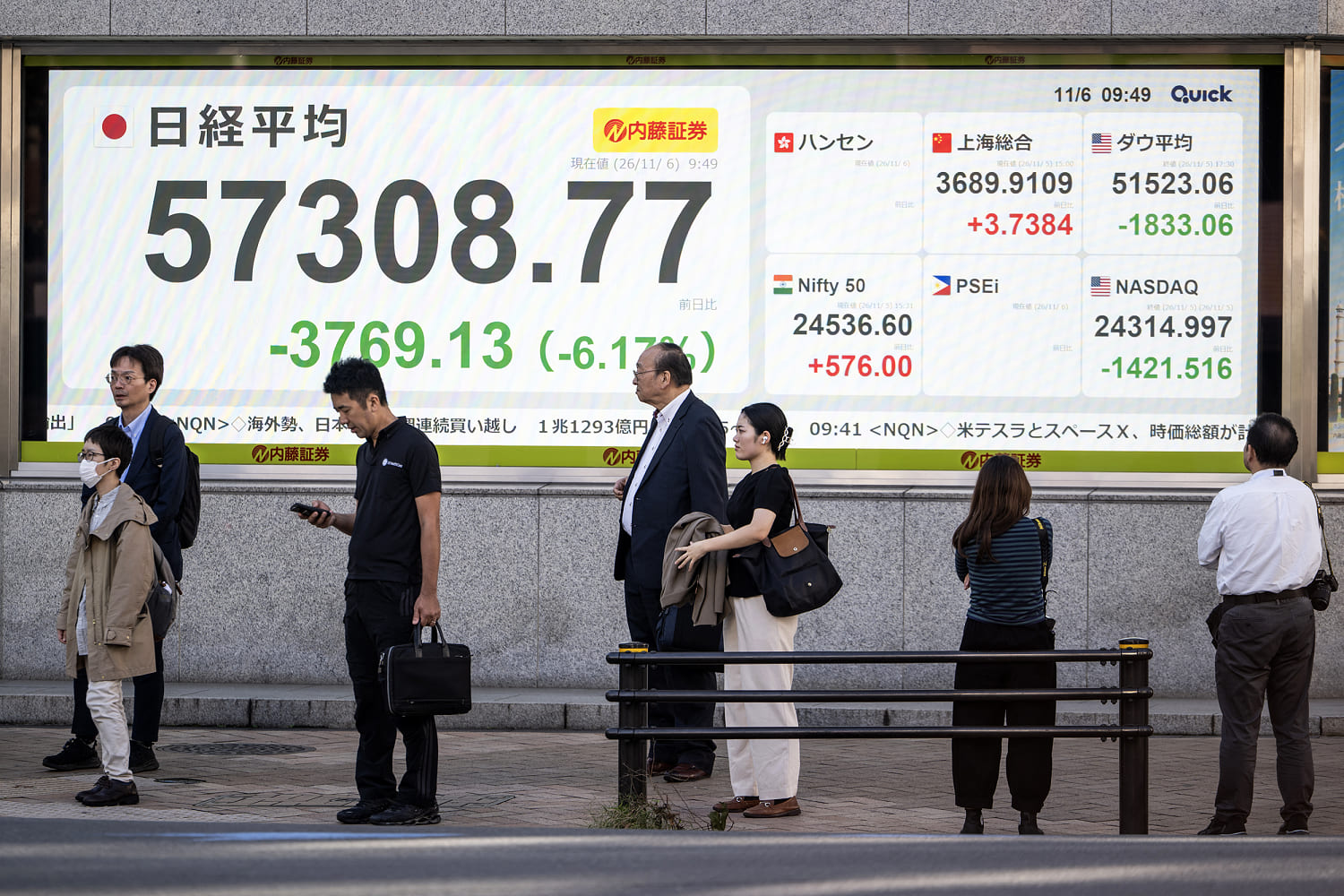
Asian stocks fell, tracking the US tech rout, with the MSCI Asia Pacific Index sliding as much as 3%. South Korea's Kospi plunged 6.2% to back below 4,700, with KRX semis down 9.6% and foreigners selling $1.4 billion of tech according to Goldman's Rachel Hu, while Taiwan's Taiex sank 4.8% (TSMC was down as much as 9% before paring to -3.6%, and MediaTek fell 10% on US tariff fears). Japan's Nikkei 225 dropped 2.8% to 57,012 as Advantest (-12.9%), Tokyo Electron (-12.5%) and SoftBank (-14.8%) cratered, with Advantest alone accounting for about 47% of the index's decline. The Hang Seng fell 1.1% for a seventh straight drop while the Shanghai Composite lost about 1.5% on reports the US will hike tariffs on China. Australia's ASX 200 dipped 0.4% after hotter than expected CPI. The lone bright spot was India: the Nifty rose 1.6% as the "AI hedge" rotation lifted Indian stocks, which have rallied 12% this month on a near-record $14 billion of foreign inflows.
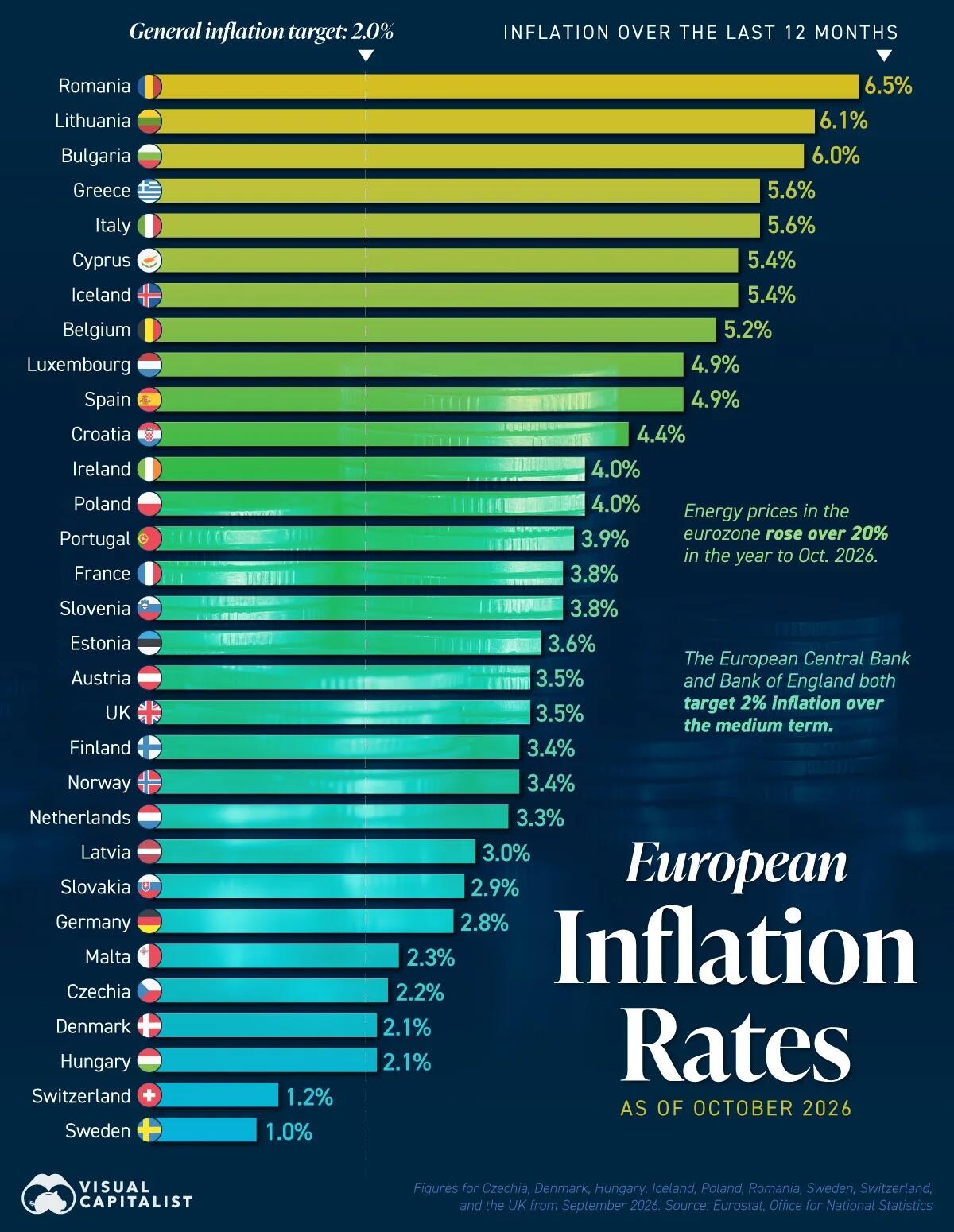
In FX, the Bloomberg Dollar Spot Index is up 0.2% and the DXY is holding just above 104.00, off the multi-year high of 104.53 hit a few sessions ago, as haven flows rather than rate differentials have become the dominant driver of currencies. Goldman's Kanter notes that even as AI pulled US relative equity performance off its highs, the DXY reached new ones, while the bank's G10 spot desk calls these "adult swim kind of markets". The Swiss franc leads G10, with EUR/CHF down 0.4% to 0.9123, the lowest since June 1, and the yen is flat with USD/JPY around 159.30. The Aussie is the clear laggard, sliding 1.2% to a 2026 low of 0.6559 after an initial pop on October CPI of 4.9% (vs 4.7% expected), while EUR/USD is down 0.3% at 1.0938 and cable slips 0.3% to 1.3075. In EM, the Hungarian forint leads a broad decline while the Indian rupee jumps to a March high on record equity inflows.
In rates, Treasuries are richer across the curve, with yields 6-8bps lower as the tech rout sparks another flight to quality; the 10Y fell as much as 9bps to 4.84% and the 2Y is at 4.62%. Notably, the correlation between chip stocks and yields has turned positive: over the past six weeks, a 1% rise in the SOX has corresponded to a 0.76bp increase in the 2Y yield. The rally faces two tests today: the October PCE report, the last inflation print the Fed will see before its Dec. 9 meeting, where money markets assign a 97% chance of a 25bp hike, and the $44 billion 7-year auction at 11:30am, which follows Tuesday's ugly 5-year sale, which tailed for a 13th consecutive time. In Europe, bunds are up about 40 ticks and gilts outperform, with the UK 10Y down 5bps to 5.14%, helped by a 4% drop in Dutch TTF gas prices on milder weather forecasts; the market shrugged off Ofgem's 26% hike in the household energy price cap, which was well flagged. Germany sold €3.8 billion of 10-year bunds at an average yield of 3.22% with a 1.4x bid-to-cover.
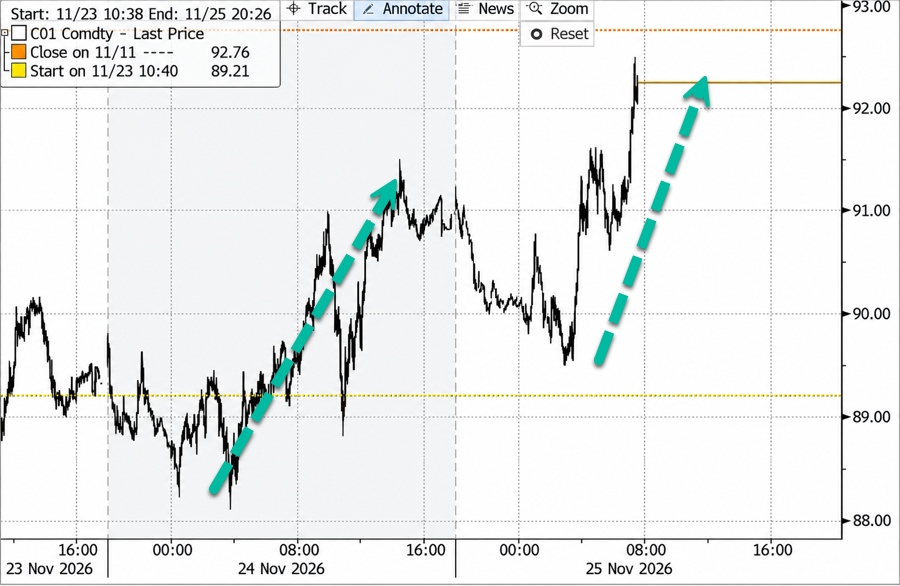
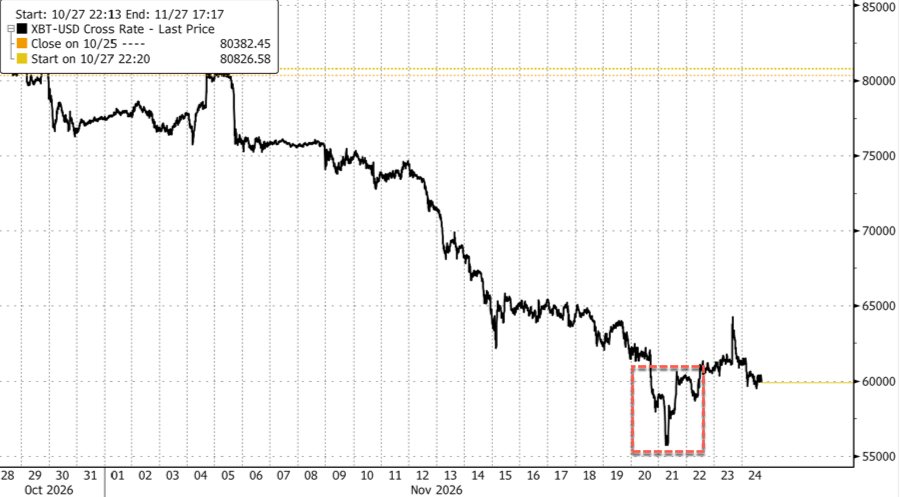
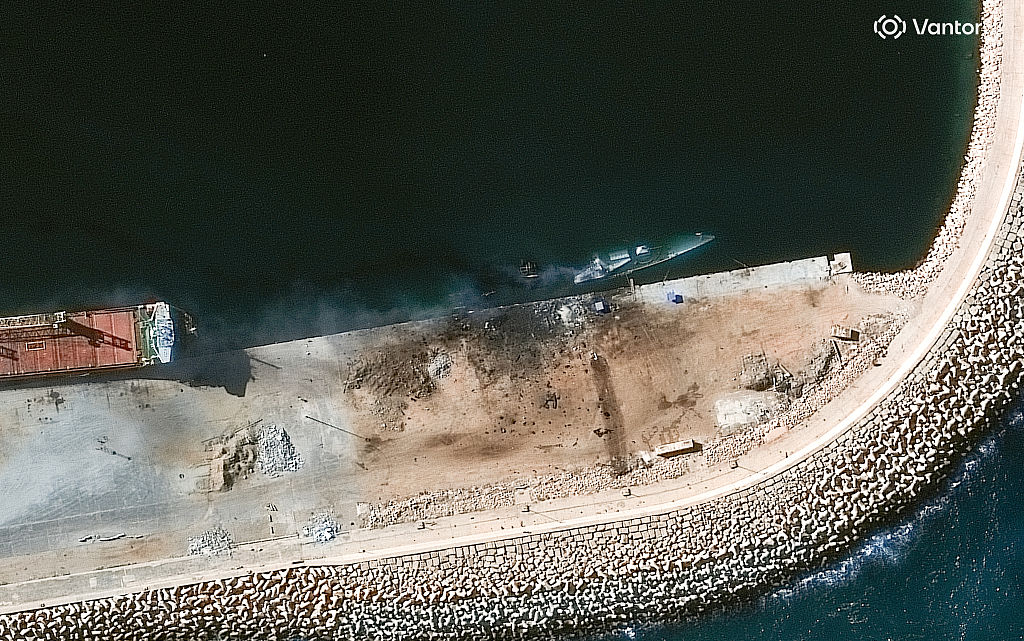
In commodities, oil is choppy, with WTI down 0.6% at $81.57 within an $80.13-$81.97 range and January Brent off 0.2% at $91.20 after paring most of its overnight losses as Yemen's Houthis confirmed attacks on Saudi Arabia's 550k b/d Ras Tanura refinery and a Riyadh financial center, and Iran's IRGC claimed two tankers caught fire after hitting mines in the Strait of Hormuz; Iran's army also said it shot down two US drones near the waterway. Offsetting that, Asian buying of US crude for December loading has fallen to the lowest since 2018 and India's purchases of Russian oil are set to drop to pre-war levels. In Russia, Ukrainian drones probably hit the Syzran and Kuibyshev refineries. Dutch TTF is down about 4%. Spot gold is down 0.8% at $3,531 after dipping as low as $3,512.58, with Goldman's James McGeoch calling $3,500 "significant" and noting there is not much support below it; silver slides 1.6% to $40.23 and is now down nearly 45% year to date, while copper, aluminum and tin extend Tuesday's fierce selloff as CTAs flip to net short. Bitcoin dropped below $59,000 as US-listed bitcoin ETFs head for their worst month of outflows, nearing $5 billion.
US economic data slate includes MBA mortgage applications (7am), October personal income, spending and PCE, Q3 GDP (second estimate), initial jobless claims and preliminary October durable goods (8:30am), and October new home sales (10am); the EIA crude inventory report is out at 10:30am, the Baker Hughes rig count at 1pm (two days early) and the Fed's Beige Book at 2pm. Fed speaker slate includes Bowman on banking supervision (7:25am). US markets are closed Thursday for Thanksgiving, and bond and equity markets close early on Friday.
On the corporate calendar, Deere reported before the open and CleanSpark is also due; there are no major investor days of note ahead of the holiday.
Market Snapshot
Top Overnight News
- China dismissed the prospect of new US tariffs on its exports as "political maneuvering" and said the two nations should work together to maintain their trade truce: BBG
- President Trump told The Post that his war effort with Iran is "funded" through January as he swiped at congressional Democrats threatening to halt the conflict, which he said would turn a "total win" into "a loss": NY Post
- Democratic Senate leader Chuck Schumer accused Nvidia CEO Jensen Huang of violating US export control law by shipping advanced chips to China, likening it to "selling rocket engines to the Soviets during the Space Race": Reuters
- President Trump will meet with Sen.-elect Abdul El-Sayed to discuss passing the "Medicare for All" plan as "Trumpcare," he told The Post, saying he and Democrats could do "great things together": NY Post
- Eurozone leaders seem all but guaranteed to pick Pablo Hernández de Cos as the ECB's next president at a summit this week: FT
- The BOJ's indicator for more fundamental inflation accelerated to a three-year high, with consumer prices excluding fresh food and special factors up 3.5% in October, supporting the case for another rate hike: BBG
- The BOJ may hike its key rate three more times to 2% by mid-2027, taking it to a level not seen since 1993, former board member Makoto Sakurai said: BBG
- Goldman's economists estimate that October personal income and spending rose 0.3% and 0.4%, respectively, with core PCE up 0.29% month-over-month (3.24% year-over-year) and headline PCE up 0.32% (3.83% year-over-year) in today's 8:30am report: GS
- Starbucks has tapped advisers to prepare a potential sale of its Japan business for several billion dollars, with a formal process possibly starting as soon as this year: BBG
- Major cyclical-to-defensive rotations have historically lasted around 4 months, with 10-15% outperformance: GS
- Australia's CPI for October ran hot at +4.9% year-over-year, up from +4.3% in September and ahead of the +4.7% consensus: WSJ
- Japan's services PPI accelerated to +4.2% year-over-year in October, up from +3.8% in September and above the +3.6% consensus: Reuters
- US President Trump said he is willing to pardon Nvidia (NVDA) CEO Jensen Huang if needed and that Huang is probably fine without a pardon, adding that Huang should tell the truth to Congress and doesn't need to plead the 5th to Congress: Newsquawk
- Top AI executives are reportedly pushing back against surrendering decision‑making power to AI: Axios
A more detailed look at global markets courtesy of Newsquawk
APAC stocks were mostly lower following the mixed lead from Wall Street, where tech underperformed, and the sector partially faded Monday's colossal gains as the NVIDIA-induced euphoria petered out. ASX 200 was dragged lower by underperformance in mining, materials and tech, but losses in the broader market were stemmed amid resilience in telecoms, energy and defensives, while participants digested firmer-than-expected monthly CPI data and a beat on Construction Work, which feeds into next week's GDP data. Nikkei 225 retreated amid heavy losses in tech stocks including double-digit percentage declines in the likes of SoftBank, Kioxia and Advantest, while the latest Services PPI data from Japan was hotter-than-expected. KOSPI suffered amid the losses in the South Korean tech heavyweights, while SK Group was also not helped by the Chairman's ongoing 9-year divorce dispute, with his ex‑wife rejecting a court‑mediated settlement proposal and urging him to stop appealing against the court's decision and accept the existing ruling, which would include SK shares in the division of marital assets. Hang Seng and Shanghai Comp were lower with the mainland subdued as the US reportedly prepares to increase tariffs on China, the EU and other trading partners, while Hong Kong initially bucked the trend as Xiaomi was lifted after its earnings beat expectations, despite posting a sharp 57% Y/Y drop in adj. net and with the Hang Seng Tech Index attempting to snap a 10-day losing streak, before succumbing to the risk-off mood.
Top Asian News
- China's aviation regulator is reportedly considering a consolidation of the sector from next year, including mergers and restructuring of smaller loss-making airlines, SCMP reported citing insiders.
- Japanese PM Takaichi's government is not contemplating issuing new deficit‑financing bonds for the FY27 supplementary budget, according to TBS.
- Japan is considering a requirement for firms that utilise semiconductors and other critical goods to prepare stable procurement plans, Nikkei reported citing sources.
European bourses (Stoxx 600 +0.2%) initially rebounded from Tuesday's losses but have come off best levels as the European morning progressed. Outperformance is seen in France (CAC 40 +1.0%), amid some positive single-stock stories. Another factor that may be supporting the French index is the approval of the 2026 year-end budget bill, which includes additional spending commitments for farmers, defence, education and overseas territories, while confirming the 2026 fiscal deficit will reach 5.4% of GDP. Sectors have a positive bias. Autos lead sectors higher, with Consumer Products & Services and Construction among the sector gainers. To the downside lies Tech, with Banks and Telecoms the only other sectors in the red. US equity futures are lower, following Tuesday's rangebound cash session as the global tech selloff continues to worry investors regarding the sustainability of the AI boom, according to a strategist at Panmure. As markets turn to a quiet end of the week given the Thanksgiving holiday, today's data docket is busy, headlined by US PCE. Analysts see headline PCE rising 3.8% Y/Y in October, with core prices up 3.2% Y/Y (0.3% M/M). Click for the session's European pre-market equity newsflow Click for the additional news
Top European News
- ECB reportedly postponed the decision on raising banks' unremunerated minimum reserves, with a decision expected no earlier than December and potentially delayed until spring 2027, Handelsblatt reported.
- The European Commission proposed a EUR 50bln sovereign technology equity fund to boost quantum technology development.
- France's National Assembly approved the 2026 year-end budget bill by 135 votes to 64, with 89 opposition lawmakers abstaining. The bill includes additional spending commitments for farmers, defence, education and overseas territories, while confirming the 2026 fiscal deficit will reach 5.4% of GDP (prev. target 5.0%).
- UK Ofgem lifted the Q1'27 household energy price cap by 26% Y/Y, effective from January 1. From January 1 to March 31, 2027, the price cap will be £2,166 per year.
FX
- Snapshot: G10s are mostly lower against the USD. The CHF outperforms a little, benefiting from haven demand, whilst the Aussie and Kiwi are swept away by the risk tone. The AUD is the clear underperformer, despite a hotter-than-expected inflation report, though the report keeps an RBA hold in December likely.
- DXY is firmer and holds just above the 104.00 mark, within a 103.80 to 104.10 range. The index remains off the highs made a few sessions ago which saw the index print a multi-year high at 104.53, but a hawkish PCE report later today could see the index retrace back towards that mark. The October PCE report is expected to show an acceleration in annual core inflation following the hotter-than-expected CPI report, with softer PPI inputs only partially offsetting the inflationary impulse.
- Any hawkish surprise will no doubt further bake in a December hike (money markets currently assign a 97% chance of a 25bps move), and some may begin to speculate whether a larger 50bps move would be needed.
- The typical haven currencies are performing better vs peers, but only mildly so. The CHF holds in the green, whilst the JPY is essentially flat on the day. USD/JPY holds within a 159.00 to 159.49 range, remaining in close proximity to the 160.00 level. Expectations of wider Fed-BoJ rate differentials have kept the pair elevated, with the pair ultimately in a tug-of-war between haven demand and rate expectations.
- Aussie is the clear underperformer this morning in what has been a choppy session so far. AUD/USD initially jumped on the region’s hotter-than-expected inflation report, marking a session peak at 0.6664. However, as the risk tone deteriorated and as traders digested the report, AUD/USD gradually slipped to make a trough at 0.6559, where the pair currently resides.
Central Banks
- RBA's Head of Domestic Markets Jacobs said financial conditions are now clearly restrictive, although whether policy is sufficiently restrictive to tame inflation is a matter for the Board.
Fixed Income
- Fixed benefits from a modest FTQ as the tech pullback resumes with NVDA fading the Huang U-turn and the NQ -2.3%. However, USTs are yet to extend significantly above Tuesday’s best levels ahead of PCE.
- USTs are currently at the upper-end of 106-22 to 107-08 parameters, surpassing the 107-00 peak from Tuesday. As mentioned, PCE is the highlight today before supply, and ahead of the agenda reducing for Thanksgiving; however, focus today is also on tariffs, with the US set to update on and seemingly honour prior agreements, according to the FT.
- PCE is expected to follow the hotter-than-expected CPI series and show an acceleration in the key Y/Y core figure, even though softer PPI inputs have partially offset the impulse. More encouragingly, the M/M is expected, following PPI, to remain at the 0.3% pace. Overall, an as-expected series will reinforce the 25bps narrative into the December Fed, while a hotter report could see a return to some pricing around a 50bps move. Currently, CME pricing has >97% chance of a 25bps hike, and the remainder ascribed to no move, as opposed to modest pricing for 50bps in recent weeks following Waller/CPI.
- Bunds in the green, higher by around 40 ticks on the day, benefiting from the mentioned tech-pressure, an increasingly tepid European risk tone and energy benchmarks being lower, though much of that has since pared on Saudi-related updates. EGBs in particular benefit from the c. 4% move lower in Dutch TTF this morning, as the regional weather models point to higher temperatures than Tuesday’s did.
- Gilts also bid, and modestly outperform with the mentioned regional energy moves encouraging. No real reaction to the Ofgem price cap, as while the 26% increase is significant and will factor into inflation data, the magnitude has been well flagged. Ahead, aside from the mentioned US/global events, focus will be on the BoE at the TSC, where testimony will be scoured for an updated view on the c. USD 10/bbl pullback seen in Brent following the November MPR; to remind, the MPR’s forecasts were already somewhat stale in the context of the energy pullback in the sessions just before the announcement.
- Italy sells EUR 2bln vs Exp. EUR 1.5-2bln 3.00% 2028 BTP: b/c 1.60x (prev. 1.72x), average yield 3.40% (prev. 3.55%).
- Japan sells JPY 300bln in 40-year JGBs; b/c 2.63x (prev. 3.10x), highest accepted yield 4.090% (prev. 4.125%).
Commodities
- Crude benchmarks have pared the bulk of the overnight losses and continue to climb off session lows in the European morning, with Brent back above USD 88.00/bbl, as markets focus on fresh supply-side risks in the region. Yemen's Houthis confirmed attacks on Saudi Arabia's Ras Tanura refinery (550k BPD), causing fires, and on a financial centre in Riyadh, saying military operations will continue until Saudi attacks and blockades end. Meanwhile, Iran's Army said it shot down two US drones east and west of the Strait of Hormuz and will strengthen control and surveillance over the waterway.
- WTI Jan'27 trades within a USD 80.13-81.97/bbl range (vs yesterday's USD 79.07-82.13/bbl range), while Brent Feb'27 moves within a USD 86.95-88.75/bbl range (vs yesterday's USD 85.63-88.87/bbl range). Dutch TTF underperforms within a EUR 86.61-91.78/MWh range (vs yesterday's EUR 87.96-92.59/MWh range), hit by regional weather forecasts inching higher for early-December, offsetting Naftogaz reporting a Russian attack on its gas facilities in Ukraine's Poltava region.
- Spot gold remains pressured after slipping beneath yesterday's trough, within a USD 3,512.58-3,575.29/oz range (vs yesterday's USD 3,546.64-3,678.49/oz range), with a firmer Dollar and lingering hawkish Fed bets weighing as participants await the Fed's preferred inflation gauge later today. The October PCE report is expected to show an acceleration in annual core inflation following the hotter-than-expected CPI report, with softer PPI inputs only partially offsetting the inflationary impulse (full Newsquawk primer available). Spot silver is lower within a USD 40.03-41.47/oz range (vs yesterday's USD 40.69-44.02/oz range).
- Copper futures are subdued within a USD 5.28-5.44/lb range (vs yesterday's USD 5.32-5.65/lb range), after recent selling pressure and amid the downbeat risk sentiment following the tech-led losses in Asia-Pac.
- US Weekly Private Inventory Data (bbls): Crude +0.1mln (exp. +0.9mln), Gasoline -0.0mln (exp. +1.8mln), Distillate +1.6mln (exp. +1.4mln), Cushing -0.7mln.
- Saudi September oil exports rose by 25.6% Y/Y, according to government data.
Trade/Tariffs
- China's MOFCOM said it held talks with the US on agriculture as part of the Board of Trade.
Geopolitics: Middle East
- US President Trump said the Iran war is funded through to January and that Israel’s goal of ending the Islamic Republic is “probably doable”, but it isn’t his objective, according to The New York Post.
- Iranian Foreign Minister Araghchi accused the US of crippling the global chemical weapons watchdog and said by obstructing the mandate of the Organisation for the Prohibition of Chemical Weapons, the US is deliberately putting global peace and security at risk.
- Iran's Army said it shot down two US drones, a LUCAS and an MQ-9, using domestic air defence systems east and west of the Strait of Hormuz, Nour News reported. Furthermore, the Army said it will strengthen control and surveillance over the Strait of Hormuz following orders from the Commander-in-Chief.
- IRGC Navy said it struck a container ship near Khasab, south of the Strait of Hormuz, while it later announced that two tankers caught fire while sailing non‑authorised routes in the Strait of Hormuz.
- Yemen's Houthis confirmed attacks on Saudi Arabia's Ras Tanura refinery (550k BPD), causing fires, and a financial centre in Riyadh. The spokesperson said military operations will continue until Saudi attacks and blockades end.
- Saudi-led coalition issued an evacuation warning for Yemen's Hodeidah port, while the Houthis threatened to target Jeddah Port and other Saudi Red Sea ports if Hodeidah was attacked. Furthermore, the Houthi-run Saba News Agency reported strikes on the Hodeidah port shortly after the warnings.
Geopolitics: Ukraine
- Russia's Samara region suffered power cuts following a drone attack, according to the regional governor cited by Russian news agencies.
- Ukraine's state-owned Naftogaz said Russia attacked its gas facilities in the Poltava region.
Crypto
- Bitcoin slips further below USD 60k amid the downbeat risk tone in the US, as tech stocks resume their selloff.
US Event Calendar
- 7:00am: Nov 20 MBA Mortgage Applications, prior -2.3%
- 8:30am: Oct Personal Income, est. 0.4%, prior 0.2%
- 8:30am: Oct Personal Spending, est. 0.4%, prior 0.5%
- 8:30am: Oct PCE Price Index YoY, est. 3.8%, prior 3.6%
- 8:30am: Oct Core PCE Price Index MoM, est. 0.3%, prior 0.3%
- 8:30am: Oct Core PCE Price Index YoY, est. 3.2%, prior 3.1%
- 8:30am: 3Q S GDP Annualized QoQ, est. 3.5%, prior 3.4%
- 8:30am: 3Q S Personal Consumption, est. 3.9%, prior 3.8%
- 8:30am: 3Q S GDP Price Index, est. 2.3%, prior 2.3%
- 8:30am: 3Q S Core PCE Price Index QoQ, est. 2.5%, prior 2.5%
- 8:30am: Nov 21 Initial Jobless Claims, est. 200k, prior 203k
- 8:30am: Nov 14 Continuing Claims, est. 1740k, prior 1763k
- 8:30am: Oct P Durable Goods Orders, est. 0.7%, prior 1.9%
- 8:30am: Oct P Durables Ex Transportation, est. 0.5%, prior 0.5%
- 10:00am: Oct New Home Sales, est. 650k, prior 676k
- 10:00am: US to sell $105bn 4-week bills and $100bn 8-week bills
- 11:30am: US to sell $44bn 7-year notes and $75bn 17-week bills
Central Bank Speakers
- 7:25am: Fed's Bowman Speaks on Modernizing Banking Supervision
- 2:00pm: Fed Releases Beige Book
DB's Jim Reid concludes the overnight wrap
As the US winds down today into tomorrow's Thanksgiving holiday, the risk-off tone has returned over the last 24 hours, as Monday’s rebound in tech stocks lost momentum once again. If you're looking for good news, we're back to the rotation trade rather than the indiscriminate sell-off we saw towards the end of last week. So AI-exposed assets like the Philly semiconductor index (-7.88%) posted sharp declines, with the index giving up over half of its +14.03% jump on Monday. And in turn, the slump in chip stocks dragged down equities more broadly, with both the S&P 500 (-0.50%) and Europe’s STOXX 600 (-0.66%) pulling back as well. On top of that, matters weren’t helped by the latest tariff headlines, suggesting the US was preparing to raise tariffs on China, the EU and several others. So that added to the downbeat mood, and the combination also pushed the 10yr Treasury yield (-1.5bps) to a two-week low of 4.93%.
It's pretty wild out there at the moment and losses are continuing into the Asian session and led by the KOSPI (-6.21%), TAIEX (-4.80%) and the Nikkei (-3.03%), while mainland Chinese equities are softer, with the Shanghai Composite (-1.48%) and CSI 300 (-1.32%) both in negative territory alongside smaller declines for the Hang Seng (-0.21%). Meanwhile, Australia's S&P/ASX 200 (-0.39%) is modestly lower after stronger-than-expected inflation data reinforced expectations that the RBA may need to keep a tightening bias. S&P 500 (-0.78%) and NASDAQ 100 (-1.34%) futures are also adding to their losses from last night but note that Stoxx (+0.10%) futures are proving more resilient.
Digging deeper, the declines were clearest in the chip space yesterday, with Nvidia (-5.86%) losing ground after its +31.48% rebound on Monday. Other AI-exposed assets saw notable declines as well, with CoreWeave (-11.85%) down sharply after its +22.32% gain on Monday with its 5yr CDS +152bps to 1330bps and back at fresh all-time wides. However, broader equities held up comparatively well, with a majority of the S&P 500’s constituents (348) higher on the day and the equal-weighted version of the S&P 500 rising +0.53% as defensive sectors including healthcare (+2.88%) and consumer staples (+1.32%) outperformed. So the situation is still notably better than at the lows last Friday, with the market moving back into a rotation trade we’d seen play out earlier this autumn rather than the broad sell-off we saw last week. Indeed, the S&P 500 is still out of technical correction territory, and the VIX (-0.26pts to 26.36) managed to continue Monday’s pullback, ending the day well beneath Friday’s close of 35.89pts.
Clearly the latest declines have revived questions as to whether this selloff has further to run. But so far at least, the current moves don’t have any of the characteristics that accompanied the outright bear markets of recent decades. Henry looked at this in a note yesterday (link here), where he pointed out that all the bear markets in the last 50 years for the S&P 500 have featured at least one of an outright recession, widespread expectations of a recession, or a Fed tightening cycle with multiple rate hikes. Indeed, the last time a bear market happened without one of those three factors was arguably the so-called “Kennedy Slide” of 1962, so it would be very unusual historically if we did get there from the current setup.
Alongside the tech selloff yesterday, the mood wasn’t helped by headlines pointing towards higher US tariffs. We first heard from the WSJ, who reported that the US was preparing to raise tariffs on China, the EU and 14 other trading partners following Section 301 investigations into alleged excess industrial overcapacity. And soon after, Bloomberg reported that could happen later in the day. According to the WSJ, the final tariff rates are still unclear, but Bloomberg reported that the rates wouldn’t surpass the levels set in previous trade deals and would be targeted for each economy rather than at a single rate across the board. So the US administration appears to be looking to reverse more fully the decline in the tariff rates that happened after the Supreme Court struck down the IEEPA tariffs back in February.
With the risk-off tone back once again, there were renewed questions as to how far the Fed could hike in the months ahead. For instance, the number of hikes priced in for the September 2027 meeting came down -1.2bps on the day to 69bps. And in turn, Treasury yields also fell back across the curve, with the 2yr yield (-0.9bps) edging down to 4.69%, whilst the 10yr yield (-1.5bps) fell to 4.93%. Nevertheless, futures are still fully pricing in two Fed rate hikes by March, so thus far at least, the selloff hasn’t been enough to shift market pricing away from further tightening. Also limiting the extent of the yield decline was a recovery in oil prices from Monday’s 3-month low, with Brent crude up +2.27% to $91.40/bbl. However, Brent is back down -1.59% this morning and US Treasury yields are 3-4bps lower across the curve.
We did have some better US data yesterday with the Conference Board’s consumer confidence indicator rising by more than expected to a 22-month high of 103.3 in November (vs. 92.4 expected), though this likely in part reflected a kneejerk reaction to the midterm election results. Meanwhile, the Richmond Fed’s manufacturing index also rose unexpectedly to 3 in November (vs. -2 expected).
Earlier in the day, European markets followed a similar pattern, with equities paring back their gains from Monday. So the STOXX 600 fell -0.66%, unwinding some of its +1.81% gain on Monday. Meanwhile, the risk-off tone was clear for sovereign bonds as well, with yields on 10yr bunds (-2.5bps) falling, whilst those on 10yr OATs (-0.5bps) saw a smaller decline, and those on 10yr BTPs (+1.6bps) moved higher. That said, the Ifo’s latest business climate indicator from Germany rose to its highest since May 2023, at 90.6 in November (vs. 90.5 expected). And the expectations component was up to its highest since February 2022, at 91.9 (vs. 92.0 expected). So that echoed the tone from Germany’s flash composite PMI on Monday, which hit a 4-year high of 55.0.
Earlier today, Australian inflation data surprised to the upside, with headline CPI accelerating to 4.9% y/y in October from 4.3% in September and above consensus expectations of 4.7%, marking the strongest reading in a year. The increase was driven by higher electricity and fuel costs, while underlying price pressures also firmed, reinforcing concerns that inflation could remain above the RBA's target for longer. The RBA's preferred core inflation gauge, the trimmed mean CPI, rose to 3.8% y/y from 3.6% previously (unchanged expected), highlighting persistent underlying inflationary pressures. Housing costs remained the largest contributor to annual inflation, accelerating to 6.4% y/y from 5.2% in September.
Looking at the day ahead, US data releases include the PCE inflation data for October, along with the second estimate of Q3 GDP, the weekly initial jobless claims, the preliminary reading of durable goods orders for October, and new home sales for October. Otherwise from central banks, the Federal Reserve will release their Beige Book.